For thousands of Indian students dreaming of studying in the United States, one question often creates confusion before the college application process even begins: Should you take the SAT or the ACT?
Both exams are widely accepted by American universities for undergraduate admissions, and both can significantly influence a student’s chances of entering prestigious institutions. However, despite serving a similar purpose, SAT and ACT are quite different in structure, timing, difficulty level, and testing approach.
In recent years, as more Indian students have started applying to US universities directly after Class 12, interest in these exams has grown rapidly. Students and parents are now trying to understand which exam better matches their strengths, career goals, and university ambitions.
The good news is that most US colleges accept both exams equally. The challenge lies in choosing the one that best suits a student’s skills and exam-taking style.
What are SAT and ACT Exams?
The SAT and ACT are standardised entrance exams used by universities in the United States to evaluate undergraduate applicants. These tests assess skills considered important for college success, including mathematics, reading comprehension, analytical reasoning, and writing ability.
The SAT is conducted by the College Board, while the ACT is organised by ACT Inc..
Although both exams are accepted by nearly all major US universities, their format and focus areas differ considerably.
Main Purpose of SAT and ACT
- Undergraduate admission in US universities
- Scholarship evaluation
- Academic skill assessment
- Standardised comparison between applicants
Why These Exams Matter for Indian Students
American universities receive applications from students across different countries and education systems. Because grading standards vary globally, SAT and ACT scores help universities compare students more fairly.
For Indian students, strong scores can improve admission chances, especially at highly competitive institutions. In some cases, good scores can also help students receive merit-based scholarships.
Experts say these exams are particularly important for students targeting Ivy League universities, engineering colleges, liberal arts institutions, or highly selective programmes.
The Biggest Difference Between SAT and ACT
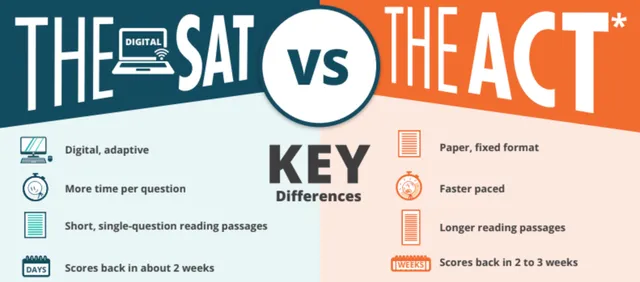
One of the major differences lies in the testing style. The SAT focuses more on reasoning and problem-solving skills, while the ACT is often considered faster-paced and more curriculum-oriented.
The ACT also includes a separate Science section, which is not present in the SAT. However, the science portion does not directly test advanced scientific knowledge. Instead, it measures interpretation of scientific data and graphs.
Core Difference
- SAT → More analytical and reasoning-focused
- ACT → Faster pace and broader subject coverage
SAT Exam Pattern Explained
The SAT has undergone major changes in recent years and is now conducted digitally in many countries, including India. The exam mainly evaluates Reading, Writing, and Mathematics skills.
The current SAT is adaptive, meaning the difficulty level of questions can change based on a student’s earlier performance during the test. This modern digital format has made the exam shorter and more flexible compared to previous versions.
SAT Sections
- Reading and Writing
- Mathematics
SAT Duration
- Approximately 2 hours 14 minutes
SAT Score Range
- 400 to 1600
ACT Exam Pattern Explained
The ACT includes four major sections: English, Mathematics, Reading, and Science. There is also an optional Writing section in some versions of the exam.
Compared to the SAT, the ACT usually contains more questions within a shorter time limit. Because of this, many students feel the ACT requires stronger time-management skills.
ACT Sections
- English
- Mathematics
- Reading
- Science
- Optional Writing Test
ACT Duration
- Around 2 hours 55 minutes
- With Writing: approximately 3 hours 35 minutes
ACT Score Range
- 1 to 36

Which Exam is Easier?
There is no universally “easy” option between SAT and ACT. The right exam depends on the student’s strengths and comfort level.
Students who prefer analytical reasoning and slightly more time per question often feel comfortable with the SAT. Meanwhile, students who can work quickly under pressure and are comfortable with science interpretation may perform better in the ACT.
Experts recommend attempting practice tests for both exams before making a final decision.
Students Who May Prefer SAT
- Strong logical reasoning skills
- Comfortable with adaptive testing
- Prefer slower pacing
Students Who May Prefer ACT
- Fast test-takers
- Strong reading speed
- Comfortable interpreting scientific graphs
Do Top US Universities Prefer SAT or ACT?
One of the biggest myths among students is that prestigious universities prefer one exam over the other. In reality, most major US universities treat SAT and ACT equally.
Institutions like Harvard University, Stanford University, Massachusetts Institute of Technology, and Yale University accept both exams.
Admissions officers generally focus more on the student’s overall profile rather than the specific exam chosen.
The Rise of Test-Optional Policies
After the COVID-19 pandemic, many US universities introduced “test-optional” admission policies. Under this system, students can apply without SAT or ACT scores.
However, experts caution that competitive scores still strengthen applications, especially for selective universities and scholarship opportunities. Many students continue to submit strong scores voluntarily to improve their chances.
Test-Optional Does Not Mean Test-Irrelevant
- Strong scores can improve competitiveness
- Helpful for scholarships
- Important for highly selective colleges
SAT vs ACT for Engineering Students
Indian students applying for engineering and STEM programmes often wonder which exam suits them better.
The SAT is sometimes preferred by students who enjoy mathematical reasoning and algebra-based problem solving. On the other hand, the ACT’s Science section may benefit students comfortable with scientific analysis and quick interpretation of graphs and experimental data.
Still, universities themselves rarely prefer one over the other for engineering admissions.
How Much do these Exams Cost?
The cost of international testing has become an important concern for Indian families. Apart from exam fees, students often spend additional money on coaching, study materials, and retest attempts.
Approximate Costs
- SAT: Around ₹9,000–₹11,000
- ACT: Around ₹14,000–₹16,000
Additional fees may apply for late registration, score reporting, or optional writing sections.
How Should Students Prepare?
Experts say preparation strategy matters more than choosing the “better” exam. Students should begin by understanding the exam pattern and identifying personal strengths and weaknesses.
Mock tests, time management practice, and consistent reading habits are considered extremely important for both exams.
Preparation Tips
- Attempt diagnostic mock tests
- Build strong vocabulary and reading skills
- Practise timed sections regularly
- Focus on accuracy and speed
- Analyse mistakes carefully
Online Coaching vs Self-Study
With the growth of digital education platforms, many students now prepare online instead of joining traditional coaching centres.
Some experts believe self-study works well for disciplined students because official practice resources for SAT and ACT are widely available online. However, coaching can help students needing structured guidance and personalised feedback.
Can Students Take Both Exams?
Yes. Students are allowed to take both SAT and ACT. Some students attempt both exams initially and later focus on the one where they perform better.
Admissions experts say this strategy can help students discover their stronger testing style without limiting opportunities.
What Matters More Than Scores?
Although SAT and ACT scores are important, US universities evaluate applicants holistically. This means colleges also consider:
Other Important Admission Factors
- Academic grades
- Essays and personal statements
- Extracurricular activities
- Leadership qualities
- Recommendation letters
- Community involvement
Strong scores alone do not guarantee admission, especially at highly selective universities.
Frequently Asked Questions (FAQs)
- Which is better for Indian students: SAT or ACT?
Neither exam is universally better. The ideal choice depends on a student’s strengths, speed, and comfort level.
- Do Ivy League universities accept ACT scores?
Yes. Most Ivy League universities accept both SAT and ACT equally.
- Is the ACT Science section very difficult?
The ACT Science section mainly tests interpretation and analytical skills rather than advanced scientific theory.
- Can students apply to US universities without SAT or ACT?
Yes. Many universities now follow test-optional policies, though strong scores can still improve applications.
Conclusion
Choosing between the SAT and ACT is less about finding the “easier” exam and more about understanding personal strengths. Both exams can open doors to world-class universities in the United States.
For Indian students planning undergraduate education abroad, careful preparation, realistic planning, and self-awareness are far more important than simply following trends. The best strategy is to understand both exams, attempt practice tests, and choose the one that aligns naturally with your skills and confidence.
In the increasingly competitive world of global admissions, the smartest choice is not the most popular exam — it is the exam where a student can perform at their absolute best.