Introduction
Sit with any old Hindu scripture for a while, and something quietly fascinating begins to emerge. The world described there is not limited to the soil beneath our feet or the sky above our heads. The ancient seers imagined existence as something far more layered — almost like a many-storeyed universe where different kinds of beings live on different levels.
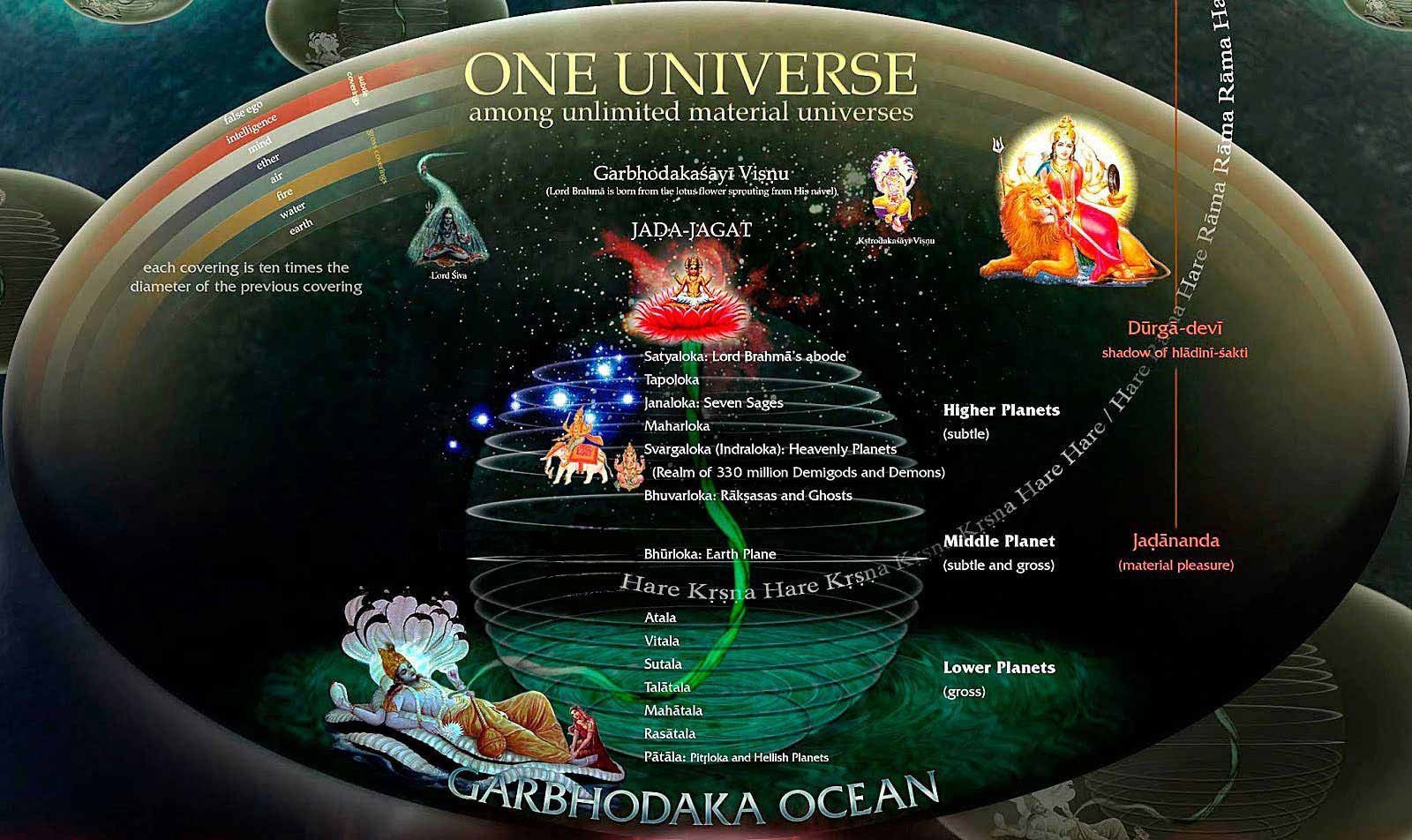
For many people, the familiar phrase is Trilok, the three worlds. It sounds simple enough: heaven above, Earth in the middle, and the nether regions below. But the deeper you go into the tradition, the more detailed the picture becomes. These three worlds are actually expanded into fourteen separate realms, each with its own character, inhabitants, and purpose in the cosmic order.
Understanding Brahmand ke 14 Lok is not only about mythology or religious belief. It is also about seeing how the ancient Indian mind tried to make sense of life, destiny, and the mysterious journey of the soul. And once you begin to look at it that way, the whole structure feels less like a fantasy and more like a thoughtful attempt to explain the invisible layers of existence.

Trilok: The Threefold Structure of the Universe
In Hindu cosmology, the universe is broadly arranged into three primary regions: Swarg Lok, Bhu Lok, and Patal Lok. At first glance, the idea feels almost intuitive — something higher than us, something where we currently live, and something hidden below.
But the sages did not stop at broad categories. They described the cosmos with remarkable patience, dividing these three regions into fourteen bhuvanas. Seven rise upward into increasingly subtle planes of existence. Seven descend into deeper, more hidden realms beneath the Earth.
And right in the middle sits Prithvi, our world — not at the top, not at the bottom, but exactly between the two directions. That placement is not accidental. In the traditional view, human life stands at a crossroads. What one does here — how one thinks, acts, and lives — quietly shapes the soul’s onward movement.
Swarg Lok: More Than Just a Heavenly Reward
When people hear the word Swarg, the mind often jumps to a glittering paradise — music, fragrance, comfort, and divine beauty everywhere. The scriptures do describe it in glowing terms. It is said to be the realm where many well-known deities reside: Indra, Surya, Chandra, Vayu, Agni, Varuna, and the revered teacher Brihaspati. Celestial dancers, the apsaras, are also associated with this luminous world.
But there is an important nuance that sometimes gets lost in popular storytelling. In many traditional interpretations, Swarg is not the ultimate destination of the soul. It is more like a temporary station of reward earned through good karma performed on Earth.
In other words, even heaven, in this framework, is part of the journey — not the final stop. That single idea already tells us how dynamic the ancient worldview was.
Bhu Lok: The Real Turning Point
If Swarg is the place where results are enjoyed, Bhu Lok — the Earth — is where the real work happens.
This is the realm of effort, confusion, choice, and growth. Humans live here, along with animals, birds, insects, and countless visible and invisible life forms. But what makes Earth special in Hindu philosophy is not just that life exists here. It is that karma is actively created here.
Ancient thinkers repeatedly emphasised how rare human birth is supposed to be. Why? Because only in this middle realm does the soul have the freedom to act in ways that can either bind it further or slowly move it toward liberation. In the higher worlds, beings mostly experience the results of past deeds. In the lower worlds, instinct and power dominate. But here, on Earth, there is choice — messy, difficult, precious choice.
Seen from that angle, Bhu Lok becomes far more than just our physical planet. It becomes the decisive chapter in the soul’s long story.
Patal Lok: The Misunderstood Depths
Mention Patal Lok in casual conversation, and many people immediately imagine darkness, fear, and punishment. But the classical descriptions are far more textured than that.
The lower realms are said to be inhabited by powerful beings — daityas, danavas, yakshas, and great serpent races. One of the most respected figures connected with these regions is King Bali, who, according to tradition, rules the realm of Sutal after receiving divine grace.
Interestingly, some Puranic passages describe parts of the nether worlds as astonishingly rich and beautifully constructed — in some respects even more luxurious than heaven. This detail alone tells us that ancient cosmology was not built on a simple moral cartoon of “good place above, bad place below.” The structure is more layered, more morally complex, and frankly more interesting than that.
How the Fourteen Worlds are Described
The detailed mapping of these realms appears in the Vishnu Purana, which lays out the fourteen bhuvanas as seven higher and seven lower worlds. The arrangement creates a kind of vertical universe where each level represents a different quality of existence.
As one moves upward, the realms become increasingly subtle, calm, and spiritually refined. As one moves downward, the worlds become denser, more materially intense, and populated by beings of great power and appetite.
Whether taken literally or symbolically, it is a remarkably systematic vision for such an ancient text.
The Seven Higher Worlds: A Gradual Ascent
At the very top stands Satyalok, also known as Brahmalok — the realm associated with Brahma and highly evolved beings. Just below it is Tapolok, the domain of intense ascetics absorbed in deep spiritual practice. Then comes Janlok, linked with the mind-born sages of Brahma.
Maharlok follows as the residence of great seers like Bhrigu, and it is said to endure even during partial cosmic upheavals. Dhruvlok, connected with the Pole Star, symbolises stability in the cosmic order. Siddhalok (or Bhuvarlok) occupies the subtle space between Earth and the Sun, housing spiritually accomplished beings. Finally, the sequence reaches Prithvilok — our familiar world.
Read slowly, the arrangement almost feels like a ladder of consciousness rather than merely a stack of physical places.
The Seven Lower Worlds: Power Beneath the Surface
Below the Earth lie Atal, Vital, and Sutal — the last being the well-known kingdom of King Bali. Further down stretch Talatal, Mahatal, and Rasatal, each associated with powerful non-human beings, especially the great serpent races and formidable asuras.
At the deepest level rests Patal Lok itself, often called Nag Lok and linked with the serpent king Vasuki. Far from being described as a crude underworld, some texts portray it as dazzling in its own way — richly adorned and structurally magnificent.
This again reflects the subtlety of the ancient imagination. Depth did not always mean degradation; sometimes it simply meant hidden power.
Reading the Lokas Symbolically
Many modern readers — including some traditional commentators — suggest that the fourteen lokas can also be understood symbolically. The higher worlds may represent increasingly refined states of awareness, discipline, and wisdom. The lower worlds may reflect deeper immersion in instinct, material power, and sensory pull.
From that perspective, the map of the universe begins to look uncannily like a map of the human mind itself.
Whether one accepts the cosmology literally or metaphorically, the intellectual ambition behind it is hard to ignore.
Conclusion
The idea of Brahmand ke 14 Lok is one of those concepts that quietly grows on you the more you sit with it. What first appears to be a mythological structure slowly reveals itself as a deeply layered attempt to understand existence — morally, spiritually, and cosmically.
The ancient seers were not merely spinning grand stories. They were wrestling with enduring questions about karma, destiny, and the soul’s long journey. By placing human life right in the middle of this vast structure, they were perhaps making a gentle but powerful point: what happens here, in this ordinary-looking human world, matters enormously.
And maybe that is why this old cosmic map still manages to hold our attention today — not because it demands blind belief, but because it invites quiet reflection.