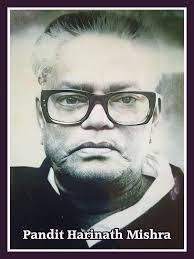
There are leaders who occupy posts, and then there are leaders who quietly become institutions. Pandit Harinath Mishra belonged to the second kind.
On his 110th birth anniversary, the Darbhanga District Congress Committee gathered not merely to conduct a formal ceremony, but to remember a man whose life still echoes in the institutions and identity of Mithilanchal. Floral tributes were offered to his portrait under the leadership of District President Dayanand Paswan, yet the gathering felt less like a political event and more like a family remembrance.
Because for many in the room, especially for Amarnath Mishra, this was not just history. It was heritage.
A Freedom Fighter Who Chose Sacrifice Over Comfort
Pandit Harinath Mishra was not just a politician; he was a freedom fighter who went to jail during the 1942 Quit India Movement. At a time when choosing silence was safer, he chose resistance.
Speakers at the event described him as a yogi and a tapasvi — a man of discipline, sacrifice, and unwavering commitment. It is said that after meeting Dr Rajendra Prasad, following a letter from Mahatma Gandhi’s secretary Mahadev Desai, something changed within him. Those who spoke about that moment described it as a turning point. He embraced a life of dedication to the nation and never looked back.
He did not marry. He did not build personal wealth. He devoted himself entirely to public life and India’s freedom struggle.
That kind of sacrifice is rare in any generation.
Amarnath Mishra’s Emotional Statement
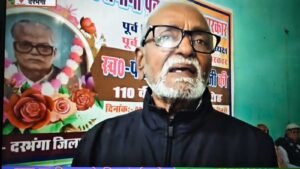
One of the most moving moments of the programme came when Amarnath Mishra, nephew of Pandit Harinath Mishra and son of Dr Bhavanath Mishra (former Professor of Medicine at Darbhanga Medical College), addressed the gathering.
Introducing himself with quiet pride, he said he belongs to the family of the great freedom fighter and former Speaker of the Bihar Legislative Assembly. He shared how it is a matter of immense honour for the family that, even after 110 years, people continue to remember Harinath Mishra with respect.
Amarnath Mishra emphasised that speaking about Pandit Harinath Mishra is not easy. According to him, reducing such a vast personality into a few sentences is almost impossible. He described him as a brave soldier of the freedom movement, a spiritual personality, and a leader deeply influenced by Rajendra Babu.
He recounted how after receiving guidance linked to Dr Rajendra Prasad, Harinath Mishra transformed into a symbol of sacrifice. From that point onward, he dedicated himself fully to the nation.
Amarnath Mishra also highlighted his political journey — from becoming an MLA in 1946 to serving continuously for decades, remaining an MLA for 31 years, later becoming Speaker of the Bihar Legislative Assembly between 1972 and 1977, and serving as Member of Parliament from Darbhanga between 1980 and 1984. He also held ministerial responsibilities at the Centre.
His voice carried both pride and responsibility — pride in the legacy, and responsibility to ensure it is not forgotten.
The Architect Behind Institutions of Mithilanchal
If Darbhanga stands tall today with institutions like Darbhanga Medical College (DMCH), Lalit Narayan Mithila University, and All India Radio Darbhanga, speakers made it clear that Pandit Harinath Mishra’s contribution cannot be ignored.
District Vice-President Ram Pukar Chaudhary specifically mentioned his role in the establishment of these institutions. DMCH, in particular, was described as a landmark achievement that gave Darbhanga a distinct identity in Bihar.
His contribution to infrastructure was not limited to education and health. When he became MP, he played a role in pushing for the Samastipur–Darbhanga broad gauge railway line, working with then Railway Minister Kamalapati Tripathi to ensure development reached the region.
There was also mention of his involvement in raising the issue of the Kosi river. It was said that his suggestions influenced discussions at the national level, and even Jawaharlal Nehru reportedly asked about his inclusion when ministerial names were being considered.
These are not small footnotes in history. These are structural contributions.
A Clean Image in a Complicated Era
Congress leaders described him as a leader of spotless integrity. He had the opportunity to work alongside Jawaharlal Nehru and Dr Rajendra Prasad — two towering figures of India’s early political landscape.
Yet, those who spoke about him emphasised that power never defined him. Service did.
Former District President Sitaram Chaudhary reminded attendees that during the freedom struggle, imprisonment did not weaken his spirit. Instead, it strengthened his resolve.
That moral clarity is perhaps what makes his memory enduring.
Why his Legacy Still Matters
In the speeches delivered, there was also a subtle message directed towards the younger generation. Several speakers argued that national recognition for Pandit Harinath Mishra is overdue. Some even suggested that his statue should be installed at Darbhanga Medical College and that he deserves honour at the national level.
But beyond political demands, what stood out was something simpler.
Pandit Harinath Mishra represents a generation that saw politics as duty, not opportunity. A generation that believed development meant building universities, hospitals, and railways — not just winning elections.
In today’s climate, remembering such figures is not about nostalgia. It is about perspective.
Remembering a Man Larger Than a Title
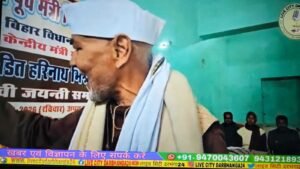
As the programme concluded at the District Congress office under the leadership of Dayanand Paswan, one sentiment was shared by almost everyone present: Pandit Harinath Mishra cannot be confined within a boundary.
His life stretched across the freedom struggle, state politics, parliamentary responsibilities, and institution-building. He moved from jail cells in 1942 to legislative halls, from grassroots activism to national policymaking.
And yet, those who knew him best remember him not for the titles he held, but for the life he chose.
Sometimes, history speaks loudly through monuments.
Sometimes, it whispers through memory.
In Darbhanga, on his 110th birth anniversary, that memory felt very much alive.