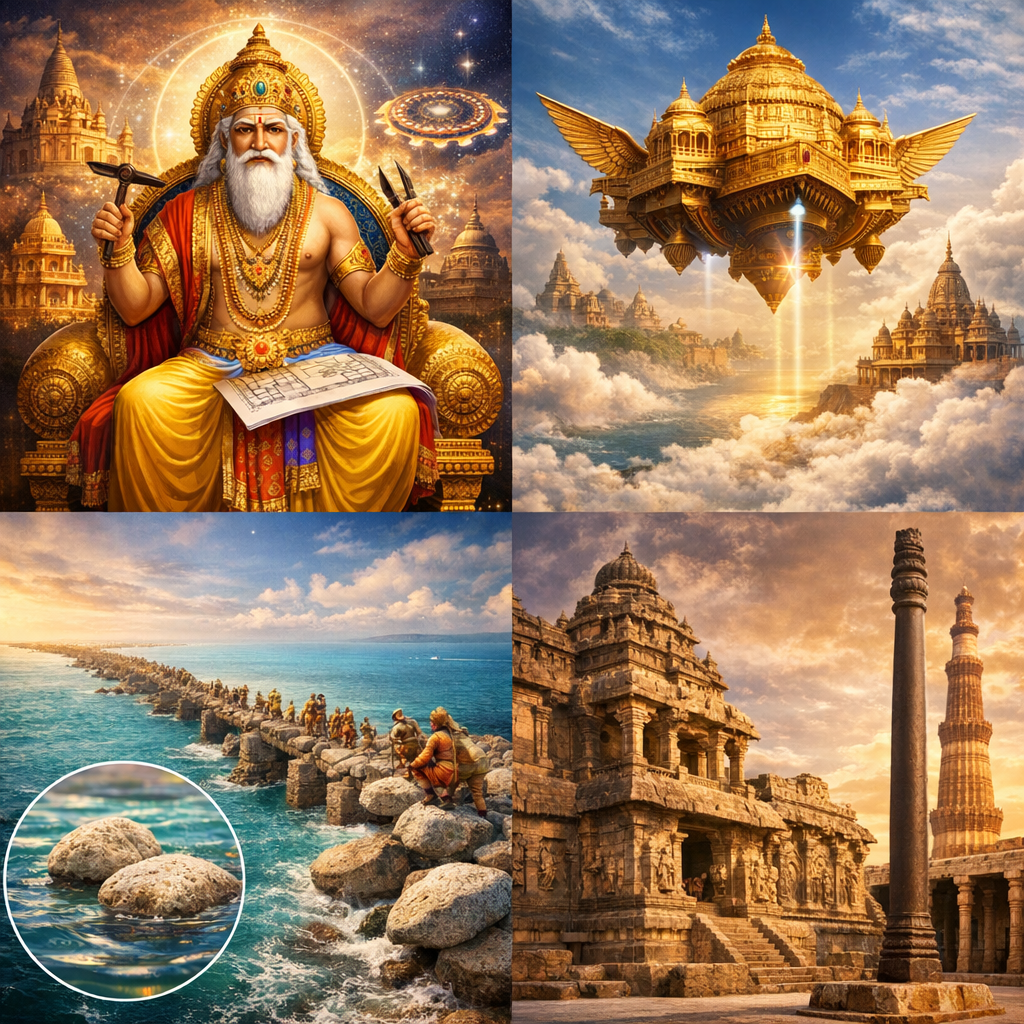
In the vast landscape of human history, where myths and science often intertwine, there exists a figure who stands at the crossroads of imagination and engineering brilliance—Lord Vishwakarma. Revered as the divine architect of the universe, Vishwakarma is not just a symbol of faith but a representation of humanity’s earliest understanding of design, technology, and innovation.
From celestial cities to advanced flying machines, from indestructible weapons to underwater civilizations, the legacy attributed to Vishwakarma challenges our modern perception of what ancient societies were capable of. Were these merely mythological exaggerations, or do they hint at lost knowledge and advanced scientific thinking?
This blog explores the fascinating world of Lord Vishwakarma, connecting ancient Indian narratives with modern engineering concepts, artificial intelligence, and futuristic technologies.
The Origin of the Divine Architect
According to ancient scriptures, when Brahma created the universe, he realized that structure alone was not enough. The cosmos needed design, function, beauty, and precision. From this realization emerged Vishwakarma—the force that transforms ideas into reality.
In today’s language, Brahma can be seen as the visionary, while Vishwakarma was the engineer, the builder, and the innovator who brought those visions to life.
The Rigveda describes Vishwakarma as “Sarva Drishta” (the all-seeing one), emphasizing his omnipresence in every act of creation. He is not confined to temples or rituals but lives in every tool, every machine, and every creative act.
The Five Forms of Vishwakarma: A Blueprint of Human Progress
One of the most intriguing aspects of Vishwakarma is his representation in five different forms. These forms are not random—they symbolically represent the stages of human technological evolution.
-
Manu – The Master of Iron
This phase marks the beginning of metallurgy. Humans learned to extract and shape iron, leading to the creation of tools and weapons for survival and protection.
-
Maya – The Architect of Wood
This stage represents early construction and transportation. From wooden homes to chariots and the invention of the wheel, this era laid the foundation of mobility and shelter.
-
Tvasta – The Metallurgical Innovator
Tvasta symbolizes the development of alloys. The mixing of metals like copper and tin to create bronze marked a significant leap in craftsmanship and utility.
-
Shilpi – The Stone Craftsman
This form represents the rise of monumental architecture—temples, forts, and sculptures. It is essentially the birth of civil engineering.
-
Vishvajna – The Master of Precious Metals
Gold and silver were not just ornaments; they were used in energy systems, temple architecture, and spiritual instruments. This phase represents refinement and sophistication in design.
Together, these five forms outline a complete journey—from primitive tools to advanced civilization.
Weapons Beyond Imagination: Ancient Engineering or Advanced Science?
Many of the creations attributed to Vishwakarma seem astonishing, even by today’s standards.
Vajra: A Bio-Engineered Energy Weapon?
The weapon of Indra, known as Vajra, was said to be made from the bones of sage Dadhichi. From a modern perspective, this raises fascinating questions.
Bones are primarily made of calcium—but what if their internal carbon structure was altered? Today, materials like graphene and carbon nanotubes are known to be incredibly strong—up to 200 times stronger than steel.
Could this be an early conceptualization of bio-engineered materials?
The Vajra is also described as a weapon that channels lightning—similar to what modern scientists call directed energy weapons.
Sudarshan Chakra: The First AI-Powered Guided Weapon?
The Sudarshan Chakra, used by Lord Vishnu, is often depicted as a spinning disc that returns to its user after eliminating its target.
In modern terms, this sounds like a guided missile or a boomerang drone equipped with artificial intelligence.
Descriptions suggest that it could distinguish between enemies and innocents—implying some form of target recognition, possibly based on heat signatures or movement patterns.
While this may sound futuristic, it reflects a deep understanding of automation and precision targeting.
Pushpak Vimana: The Ancient Flying Machine
One of the most fascinating inventions linked to Vishwakarma is the Pushpak Vimana.
Originally built for Kubera and later used by Ravana, this flying vehicle is described as:
- Moving at the speed of thought
- Requiring no fuel like petrol or diesel
- Capable of vertical take-off
- Controlled by the mind of the user
Modern scientists and innovators, including figures like Elon Musk, are exploring brain-machine interfaces—technology that allows humans to control devices using their thoughts.
What was once considered mythology now seems conceptually aligned with cutting-edge research.
Some interpretations even suggest that the Vimana might have used mercury-based propulsion or anti-gravity principles—concepts that remain largely unexplored.
Dwarka: The Underwater City
When Lord Krishna needed a secure kingdom, Vishwakarma designed the magnificent city of Dwarka—not on land, but in the middle of the sea.
Today, underwater explorations near the coast of Dwarka have revealed structures resembling ancient walls, anchors, and settlements.
Modern engineering marvels like Dubai’s Palm Jumeirah use land reclamation techniques—but the idea of building an entire city in the sea thousands of years ago is extraordinary.
It suggests a deep understanding of marine engineering, materials science, and environmental adaptation.
Ram Setu: Engineering Beyond Logic
The construction of Ram Setu, attributed to the engineers Nala and Neel (believed to be descendants of Vishwakarma), is another remarkable example.
Floating stones used in the bridge have sparked curiosity for centuries. Scientifically, stones with air pockets—like pumice—can float on water.
But the real question is: how did ancient builders select or engineer such materials, and how did they construct a 48-kilometer-long bridge without modern tools?
Kailasa Temple: A Monolithic Mystery
The Kailasa Temple is one of the greatest architectural wonders in the world.
Carved from a single rock, this temple was created by removing approximately 400,000 tons of stone. Yet, there is no clear evidence of where this massive debris went.
Even today, with advanced machines, replicating such precision would be extremely challenging.
Konark Sun Temple: Magnetic Engineering?
The Konark Sun Temple is believed to have once housed a structure where the main idol appeared to float due to magnetic forces.
Modern maglev trains use similar principles—magnetic levitation—to reduce friction and enable high-speed travel.
If such knowledge existed in ancient times, it suggests an advanced understanding of magnetism and balance.
Iron Pillar of Delhi: Rust-Resistant Metallurgy
Standing tall near the Qutub Minar, the Iron Pillar has resisted corrosion for over 1,600 years.
This remarkable durability is due to a unique composition involving phosphorus, which prevents rust formation.
Even today, scientists study this pillar to understand ancient Indian metallurgy.
Indraprastha: The City of Illusions
The legendary city of Indraprastha, built for the Pandavas, was known for its optical illusions—floors that looked like water and water that looked like solid ground.
This concept closely resembles modern technologies like augmented reality and holography.
It shows that ancient architects were not just builders but masters of perception and experience design.
Was It Science or Myth?
A common argument from skeptics is that such achievements must have been the work of aliens. However, attributing these marvels to extraterrestrial beings undermines the intelligence and creativity of ancient civilizations.
Instead, these stories may represent:
- Advanced knowledge that was lost over time
- Symbolic descriptions of scientific concepts
- Early attempts to explain complex technologies
Ancient universities like Nalanda and Takshashila once preserved vast knowledge, much of which was lost due to invasions and destruction.
Vishwakarma and Modern Science
Today, scientists at organizations like NASA are exploring space colonization, while researchers develop AI systems and smart machines.
Yet, the core philosophy of Vishwakarma remains relevant: technology should serve humanity, not destroy it.
Modern innovation often focuses on efficiency and power, while Vishwakarma’s vision emphasized harmony, sustainability, and balance.
The Deeper Message: Innovation Within Us
Lord Vishwakarma is not just a deity—he is a symbol of human potential.
Every tool we use, every structure we build, and every innovation we create reflects the same creative energy. His story reminds us that:
- Innovation is timeless
- Knowledge can be lost if not preserved
- Technology must align with ethics
Why We Must Rediscover Ancient Knowledge
In today’s rapidly advancing world, revisiting ancient wisdom is not about rejecting modern science—it’s about enriching it.
India’s past holds valuable insights into:
- Sustainable architecture
- Natural energy systems
- Material science
- Human-centric design
By combining ancient principles with modern technology, we can build a future that is not only advanced but also balanced.
Conclusion: The Legacy of the First Engineer
From flying machines to underwater cities, from indestructible metals to intelligent weapons, the legacy of Lord Vishwakarma continues to inspire curiosity and admiration.
Whether one views these stories as mythology, metaphor, or lost science, one thing is clear—ancient India possessed a deep understanding of creation and engineering.
The next time you hold a smartphone, admire a skyscraper, or watch a rocket launch, remember that the roots of innovation go far deeper than we often realize.
They trace back to a time when imagination and science were one—and that spirit lives on in the legend of Vishwakarma.
FAQ
- Who is Lord Vishwakarma?
Lord Vishwakarma is considered the divine architect and engineer of the universe in Hindu mythology, responsible for creating celestial cities, weapons, and advanced structures.
- What are the major inventions of Lord Vishwakarma?
Some of the most famous creations include the Pushpak Vimana, Sudarshan Chakra, Dwarka city, and various divine weapons used by gods.
- Was Pushpak Vimana a real aircraft?
The Pushpak Vimana is described as a flying machine controlled by thought. While not scientifically proven, it aligns conceptually with modern research in brain-machine interfaces.
- How were Ram Setu stones able to float?
Ram Setu is believed to have been built using stones with air pockets or low density, similar to pumice stones that can float on water.
- Is there scientific evidence of ancient Indian engineering?
Structures like the Kailasa Temple and the Iron Pillar in Delhi demonstrate advanced knowledge of architecture and metallurgy in ancient India.
- Why is Lord Vishwakarma worshipped today?
He is worshipped as the patron of engineers, architects, mechanics, and craftsmen. On Vishwakarma Puja, people honor tools, machines, and innovation.