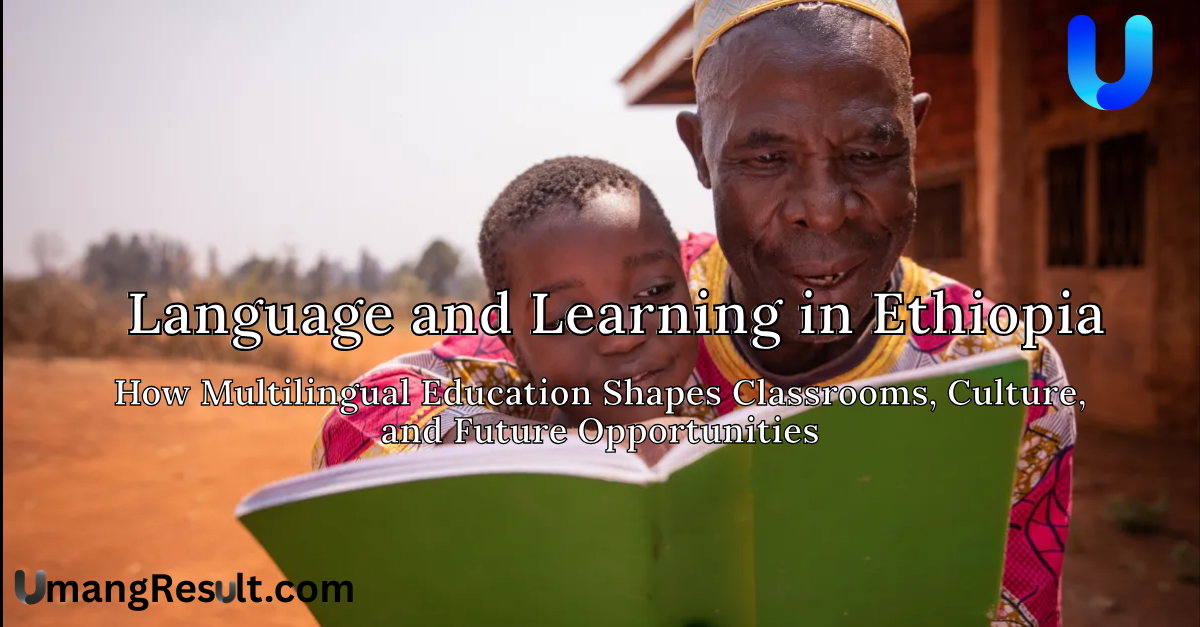
Ethiopia is remarkable for many things — ancient history, diverse landscapes, and a rich tapestry of peoples and cultures. But perhaps nothing defines daily life more than the languages people speak. Ethiopia is home to over 80 living languages, each with its own rhythms, histories, and cultural meanings. This diversity is a treasure, but it also makes education — especially formal education — an incredibly complex task.
In this blog, we explore how language influences learning in Ethiopia:
Why it matters, what challenges it creates, how the education system manages multilingual instruction, and what this means for students’ futures.
A Country of Many Tongues — A Classroom of Many Voices
When you walk through a school classroom in Ethiopia, you can sense the diversity instantly. In some places, children speak Amharic at home; in others, Oromiffa, Tigrinya, Sidamo, Somali, or one of dozens of lesser-known languages. These mother tongues are not just ways to speak — they are expressions of identity, culture, and community.
For a long time, one of the biggest questions in Ethiopian education has been:
Should students be taught in their mother tongue or in a more widely used language like Amharic or English?
The answer shapes everything: comprehension, confidence, classroom participation, even student retention.
Why Mother-Tongue Instruction Matters (But Isn’t Easy)
From the earliest grades, many educational researchers argue that children learn best in the language they use at home. It allows them to grasp concepts more deeply, ask questions without hesitation, and build a strong foundation in literacy and reasoning.
Ethiopia recognises this in policy. The government has pushed for mother-tongue instruction in early grades — especially Grades 1–4. That means a child rising in southern Ethiopia might learn reading, writing, and basic arithmetic in a language like Sidama or Wolaytta, rather than in Amharic or English.
This approach has real benefits:
- Better comprehension: Students understand lessons more deeply in a familiar language.
- Confidence building: Children participate more actively because they are not battling language barriers at the same time as new academic content.
- Cultural preservation: Schools validate local languages as vehicles of learning, not obstacles.
However, here’s where the complexity begins.
The Challenge of Transitioning to English
Around Grade 5 or Grade 6, most Ethiopian schools transition to English as the language of instruction, particularly for science, mathematics, and higher-order learning. This switch is intended to prepare students for international academic standards and global opportunities.

But in practice, this creates a steep hurdle for many learners.
Imagine this scenario:
You’ve spent four years learning math, science, and reading in your home language. You understand concepts. You can explain them when asked. But suddenly, the language changes. The words you must use to express what you know are no longer familiar.
This switch can feel like learning two sets of skills at once: academic content and a new language.
For many students, especially in rural or under-resourced schools, this transition is abrupt because:
- Teachers may not be fluent or confident in English
- Schools may not have enough textbooks or supplementary materials in English
- Students rely on translation in class rather than immersion
The result? Students who understand content may nonetheless score poorly — simply because they struggle to express ideas in English.
This has serious consequences: lowered confidence, poor test scores, and in some cases, school dropout.
Teacher Preparation and Language Training
A majority of Ethiopia’s teachers work in schools where the language of instruction shifts midway through primary education. This is especially true in regions where local languages dominate home and community life. But teacher preparation programs — the training colleges and universities that prepare educators — often don’t provide enough support for this bilingual shift.
Many teachers are excellent facilitators in local languages, but when it comes to teaching in English, they often find themselves caught between:
- Curriculum expectations
- Students who struggle to understand English explanations
- Pressure to “cover the syllabus”
What this means in day-to-day classroom life is real, human confusion: teachers repeating words in English and local language, students nodding without understanding, homework piling up like an unsolved puzzle.
Curriculum Design: Local Relevance vs. Global Standards
The curriculum dilemma is universal: how do you make education locally relevant while still preparing students for global participation?
Ethiopia’s approach — early mother-tongue instruction followed by an English transition — is inspired by research and global practice. But its implementation is uneven. The challenges include:
- Lack of educational materials in local languages — many schools still struggle with textbooks, libraries, and reading materials in indigenous languages.
- Assessment systems mostly in English — especially from secondary school onwards, testing is largely conducted in English, which disadvantages students who are not proficient.
- Curriculum content that doesn’t match students’ lived realities — urban students may find the curriculum accessible; rural students may find it abstract or distant from local experience.
This misalignment affects not just language competence, but cognitive engagement. A student who cannot articulate a scientific idea in English might still understand it deeply — but the grading system rarely recognises that subtle understanding.
Linguistic Inequality and Regional Disparities
Language intersects with geography and socio-economic status in powerful ways.
Urban areas like Addis Ababa often attract teachers with strong English skills, better resources, and regular professional development. Rural areas — where indigenous languages are stronger — often lack those same supports.
Students in rural schools are thus dealing with a double disadvantage:
- Less access to quality educational resources
- A steeper language transition later in their academic journey
This means that identical academic potential may lead to very different outcomes simply because of where a student lives and which language they speak at home.
The Digital Classroom — A New Hope?
Can technology break this language trap?
There is hope in digital education strategies that Ethiopia is beginning to explore. With mobile learning, localized e-content, and language-rich multimedia, students could access lessons in both their mother tongue and English.

But there’s a catch: technology itself isn’t evenly distributed. Urban schools often have at least basic connectivity and computers; rural schools may still be struggling with electricity and infrastructure.
Still, the potential is huge:
- Digital libraries in local languages
- Bilingual learning apps that switch between mother tongue and English
- Multimedia modules that make abstract concepts easier to grasp for learners of all backgrounds
Progress has begun, but it needs scale and sustained investment.
A Global Perspective: What Other Multilingual Countries Teach Us
Ethiopia’s situation is not unique. Countries like South Africa, India, Kenya, and others grapple with similar tensions between indigenous languages, official languages, and international languages like English.
In many of these countries, researchers and educators emphasise:
- Early mother-tongue literacy as foundation
- Gradual, scaffolded transition to second languages
- Teacher training that emphasises multilingual competency
- Assessment systems that allow bilingual expression
What this global experience suggests is that language policy cannot be static. It must adjust to learners’ needs, not the other way around.
What Students and Teachers Say — Voices From the Ground
Numbers tell part of the story, but voices tell the rest.
Many students express something like this:
“I understand the lesson when I speak Amharic or Oromo, but when the test is in English, I freeze. I know the idea, but not the words.”
Teachers often echo that concern:
“I want to teach English, but I also want my students to really get the content. Sometimes it feels like I’m teaching English more than science or math.”
These voices reveal an everyday struggle that no policy brief fully captures: the emotional cost of language barriers — nervous students, tired teachers, and parents who don’t know how to help because they face the same language hurdles.
A Vision Forward: Language, Learning, and Equity
Is there a path that honours Ethiopia’s linguistic diversity and prepares students for global participation?
Yes — but it must involve:
- Respecting Mother Tongues in Early Education
Students learn best in familiar language environments where they can ask questions without hesitation.
- Rethinking Language Transition
Instead of an abrupt shift, a gradual bilingual approach (dual language instruction) can help students feel supported while building English proficiency.
- Investing in Teacher Training
Teachers need ongoing support to manage bilingual classrooms and to design assessments that reflect comprehension, not just vocabulary.
- Expanding Digital Learning
Digital platforms tailored to local languages — with visual and interactive content — can transform classrooms where textbooks are limited.
- Rethinking Evaluation
Assessments must measure understanding, not just English expression. Allowing bilingual responses in examinations — at least at intermediate levels — can help.
Conclusion — Language Is More Than Words; It Shapes Futures
Language is not a neutral tool. It embodies culture, memory, identity, and power. In Ethiopia, where language diversity is celebrated as part of national heritage, education must find ways to honour that diversity without disadvantaging students in an interconnected world.
The challenge is real, and it’s complicated. But there is hope — not in quick fixes, but in thoughtful, sustained efforts that connect policy with classroom realities.
Ethiopia stands at a crossroads. It can either let language become an obstacle — or make multilingual learning its greatest educational strength.