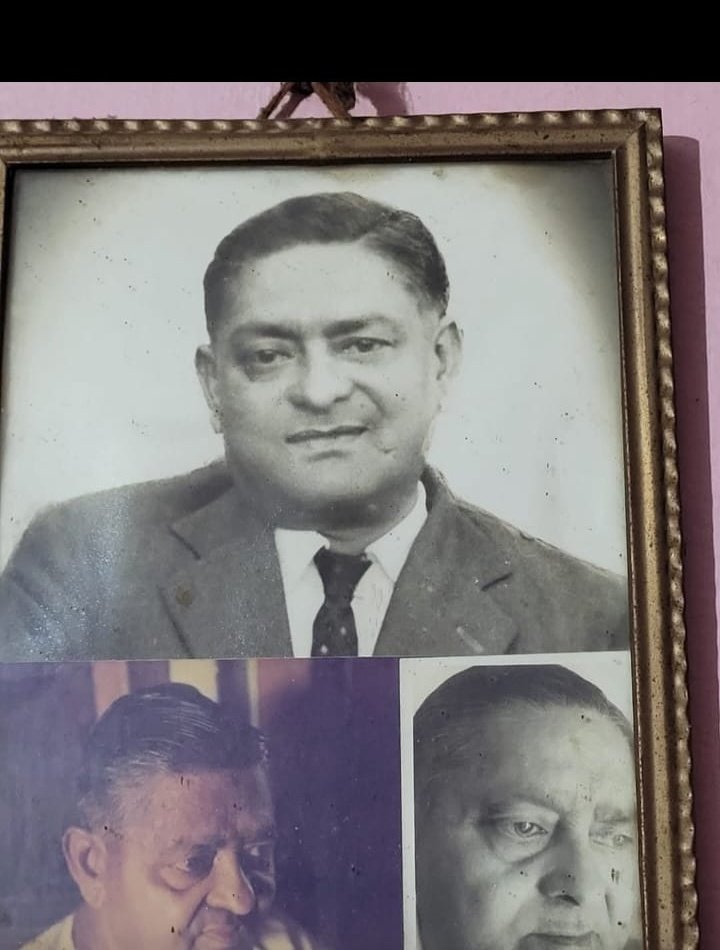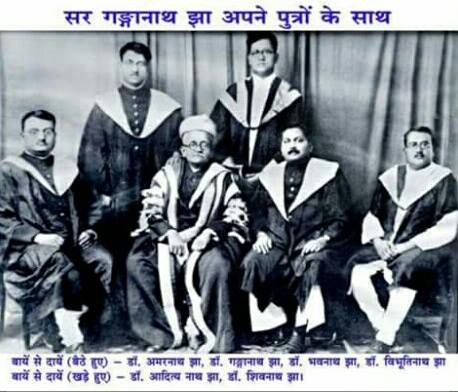
In every generation, a few individuals work silently yet leave behind footprints that time cannot erase. Mahamahopadhyaya Sir Ganganath Jha was one such personality. He was not a mass leader, nor a fiery political voice. His battlefield was the world of books, ideas, and disciplined scholarship.
What makes his story deeply moving is the quiet determination with which he preserved India’s intellectual heritage at a time when the country itself was passing through uncertainty and transition. Without noise, without self-promotion, he built a body of work that still supports students and researchers more than eight decades after his passing.
His journey—from the scholarly land of Mithila to the high office of university leadership—reads less like a dramatic tale and more like a steady river carving its path through patience and depth.
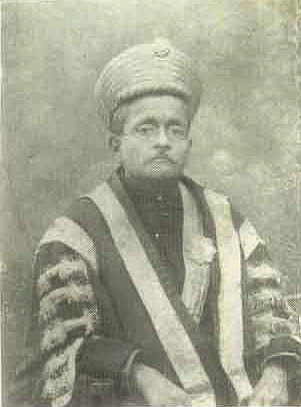
Born in the Land Where Learning Breathes Naturally
Ganganath Jha entered the world on 25 September 1872 in the Mithila region of present-day Bihar. Mithila has long enjoyed a reputation as a cradle of classical learning. In many homes there, Sanskrit was not treated as a distant academic subject but as a living intellectual tradition.
Growing up in this environment shaped young Jha in subtle but powerful ways. He was surrounded by discussions on scriptures, logic, and philosophy. Elders soon noticed something unusual about the boy. He was not satisfied merely reciting verses; he paused, questioned, and tried to understand what lay beneath the words.
That habit — the refusal to remain on the surface — stayed with him for life.
A Student Who Balanced Two Worlds
As he progressed in his studies, Jha moved through both traditional Sanskrit education and the modern academic system introduced during British rule. Many students of the time leaned strongly toward one path or the other. Jha quietly absorbed both.
This balance later became his greatest intellectual strength.
From the traditional side, he gained depth, precision, and respect for classical commentaries. From modern education, he learned structured analysis and clear academic presentation. When these two streams met in his work, they produced something rare — scholarship that was both authentic and accessible.
Teachers quickly recognised that he was not merely hardworking; he possessed unusual intellectual discipline.
The Scholar Who Made Difficult Philosophy Understandable
Over the years, Ganganath Jha built a formidable reputation as a Sanskrit scholar, especially in complex philosophical systems like Mimamsa and Nyaya. Anyone familiar with these traditions knows they are not easy reading. Their arguments are layered, technical, and often intimidating even for advanced students.
Here is where Jha’s real genius appeared.
He had the patience to walk slowly through dense arguments and the clarity to explain them in clean, careful English. Instead of oversimplifying, he guided readers step by step, almost like a patient teacher sitting beside a serious student.
Because of this, his translations did something remarkable — they opened the doors of Sanskrit philosophy to the wider academic world. Scholars who previously struggled to approach these texts suddenly found a reliable guide.
Quietly, without grand announcements, he helped Indian philosophical thought travel far beyond its traditional boundaries.
A Historic Turning Point at Allahabad
One of the most defining chapters of his life came when he was appointed Vice-Chancellor of the University of Allahabad. In colonial India, this was no ordinary achievement. He became the first Indian to hold the post.
To understand the weight of this moment, one must remember the times. Senior academic positions were largely controlled by British administrators. Jha’s appointment signalled growing confidence in Indian intellectual leadership.
Yet those who expected dramatic changes or loud assertions found something different. He led quietly.
As Vice-Chancellor, he focused on academic discipline, fairness, and institutional dignity. He believed Indian universities should modernise, certainly — but not at the cost of forgetting their own intellectual traditions.
It was a balanced vision, and it earned him deep respect.
A Life Devoted to Serious Scholarship
If administrative success brought him visibility, his real devotion remained scholarship. Ganganath Jha produced an impressive range of translations and commentaries, particularly in Mimamsa philosophy.
What stands out in his work is the care with which he handled original texts. He neither distorted meanings nor rushed through arguments. Every passage received attention. Every technical term was treated with respect.
Scholars valued his work because:
- He stayed close to the original Sanskrit
- He explained rather than diluted
- He added helpful clarifications for modern readers
- He honoured earlier traditional commentators
Because of this careful approach, many of his works became standard academic references — a position they continue to hold even today.
Standing Calm in a Time of Intellectual Change
The late nineteenth and early twentieth centuries were not easy years for traditional Indian knowledge systems. Western education was expanding rapidly, and many feared Sanskrit learning might slowly be pushed aside.
Ganganath Jha did not respond with resistance or anxiety. Instead, he chose a wiser path.
He demonstrated — through rigorous scholarship — that Indian philosophical traditions could stand confidently within modern academic frameworks. Rather than arguing emotionally, he proved his point through disciplined work.
This calm confidence made his contribution especially powerful.
Honours That Came — But Never Changed Him
Recognition eventually followed. He received the prestigious title Mahamahopadhyaya, one of the highest honours for Sanskrit scholars. He was also knighted and came to be known as Sir Ganganath Jha.
Yet, by all accounts, honours did not alter his personality. He remained deeply focused on study, teaching, and intellectual work.
Students often remembered not his titles but his quiet presence — a teacher who inspired seriousness without raising his voice.
The Influence that Refuses to Fade
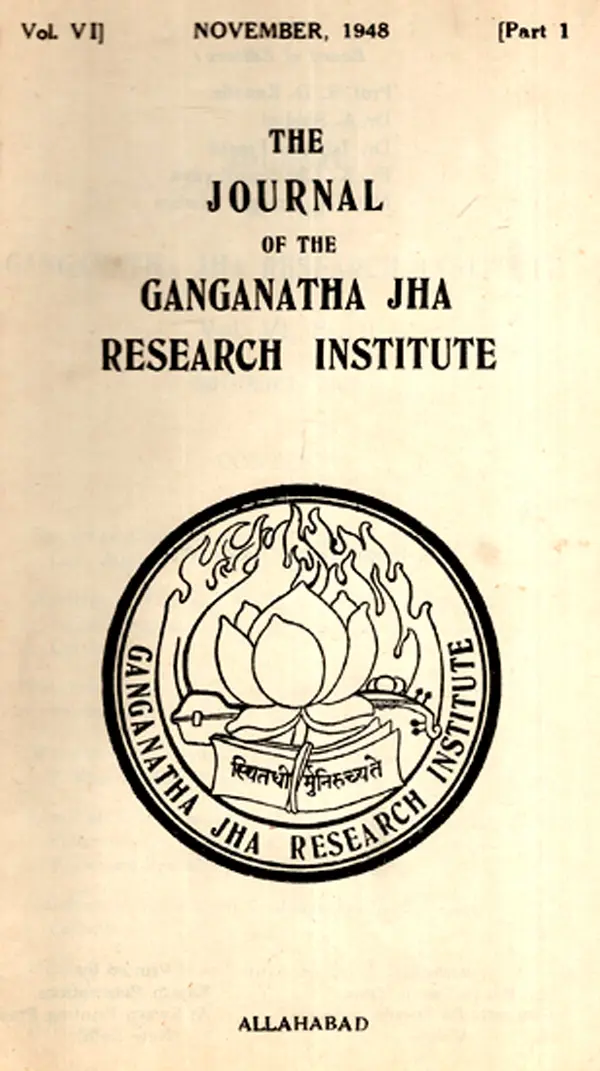
When Ganganath Jha passed away on 17 November 1941, his physical journey ended, but his intellectual presence did not. His translations continued circulating in universities. Researchers continued citing his work. Sanskrit departments continued relying on his clarity.
Even today, serious students of Indian philosophy frequently encounter his name while navigating complex texts.
That is the true test of scholarship — not momentary fame, but lasting usefulness.
Why His Story Still Feels Relevant Today
In today’s fast-moving academic world, where information often travels faster than understanding, Jha’s life offers a quiet but powerful lesson.
He reminds us that:
- Deep knowledge grows slowly
- Translation is an act of responsibility
- Cultural confidence comes from intellectual rigour
- True scholars work more than they speak
For students, especially those coming from regions rich in traditional learning like Mithila, his journey carries special emotional strength. It shows that rooted scholarship can achieve global respect.
FAQs About Ganganath Jha
Q1. Who was Ganganath Jha?
Ganganath Jha was one of India’s most respected Sanskrit scholars, known for his authoritative translations of complex philosophical texts and for serving as the first Indian Vice-Chancellor of the University of Allahabad.
Q2. Why is Ganganath Jha famous?
He is famous for making difficult Sanskrit philosophical works—especially Mimamsa texts—accessible to modern scholars through clear and faithful English translations.
Q3. When and where was Ganganath Jha born?
He was born on 25 September 1872 in the Mithila region of present-day Bihar, India.
Q4. Which university did Ganganath Jha lead?
He served as the Vice-Chancellor of the University of Allahabad and was the first Indian to hold this prestigious position.
Q5. What was the title Mahamahopadhyaya given to him?
Mahamahopadhyaya was a highly respected scholarly honour awarded to distinguished Sanskrit scholars. It recognised his exceptional contribution to classical Indian learning.
Q6. What is Ganganath Jha’s legacy today?
His translations and commentaries continue to be widely used by students and researchers of Indian philosophy across the world. He is remembered as a bridge between traditional Sanskrit scholarship and modern academia.
Conclusion: Remembering a Scholar Who Worked in Silence
History often celebrates loud moments and dramatic personalities. But the preservation of civilisation depends equally on patient scholars working far from the spotlight. Ganganath Jha was one of those rare builders of intellectual continuity.
Through disciplined study, careful translation, and dignified academic leadership, he ensured that a vast portion of India’s philosophical heritage remained accessible to future generations.
His life does not shout. It quietly endures. And even today, serious students continue to walk the path he helped illuminate.