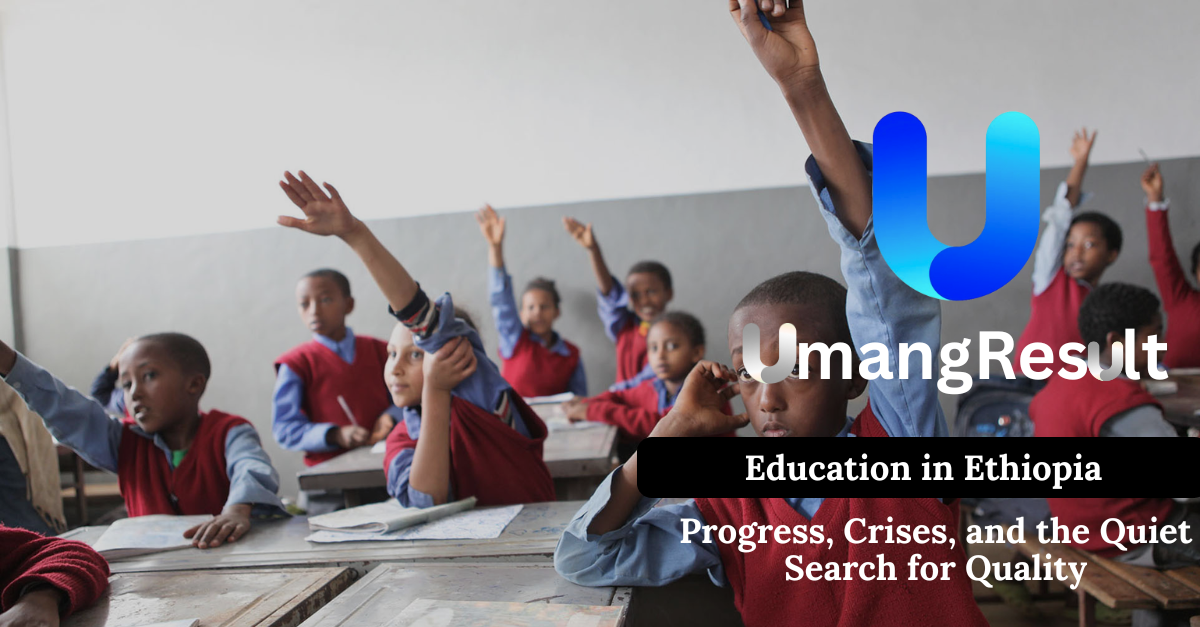
If you listen closely to conversations about education in Ethiopia, you’ll notice a pattern. On paper, things look better than ever. Enrollment numbers are up. Schools exist in places that once had none. Universities have multiplied across the country.
But when parents talk among themselves, or when students speak honestly, a different story emerges — one filled with worry, frustration, and unanswered questions. Education in Ethiopia is no longer just about getting children into school. It is about whether those years in school are actually changing lives.
And that question remains painfully unresolved.
A System That Expanded Faster Than It Could Steady Itself
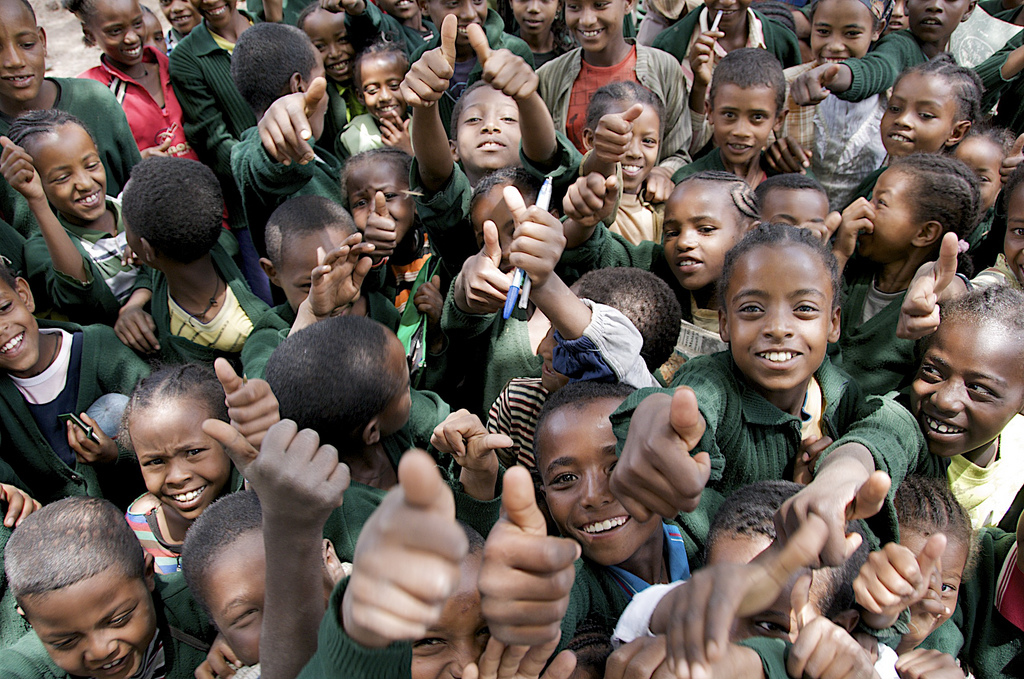
Over the past twenty years, Ethiopia built schools at a remarkable pace. Millions of children entered classrooms for the first time. Public education was made free across primary, secondary, and even higher education. For many families, this felt like a long-delayed promise finally being honoured.
In villages where schooling once seemed distant, classrooms suddenly became part of everyday life.
Yet growth came rushing in before the system had learned how to carry it.
Teachers were appointed faster than they could be trained. Schools opened without libraries, laboratories, or even electricity. Lessons became crowded, rushed, and exam-focused. Learning slowly turned into something mechanical — memorise, repeat, move on.
The results now speak for themselves. When only about 8 percent of students pass the Grade 12 examination, it forces a difficult question: What exactly happened during all those years of schooling?
For families, this failure is not theoretical. It is lived. A child studies for over a decade, reaches the final exam, and suddenly discovers that effort alone was never enough.
Where the Journey Begins to Falter
Ethiopia’s education system holds children well at the starting line. Most enroll in primary school. Attendance at early grades is relatively strong.
But as the years pass, students begin to disappear.
Only about one in three students reaches upper secondary education. Girls, rural learners, and children from low-income households are the first to slip away. Some leave to work. Some lose motivation. Some simply fall through cracks no one was watching.
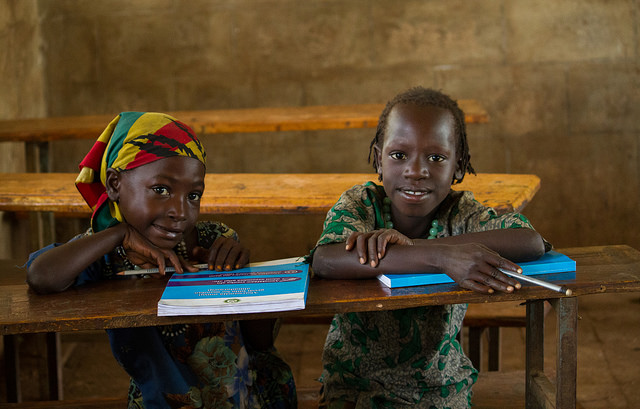
Even those who remain face daily limitations. Many schools still function without reliable electricity. Libraries, when they exist, often sit underused or understocked. Science is taught without experiments. Reading is taught without books.
Learning, under such conditions, becomes an act of endurance rather than curiosity.
When Conflict Turns Classrooms Silent
There are places in Ethiopia where education has not merely weakened — it has stopped.
Conflict in regions such as Tigray and parts of Amhara has closed schools, damaged buildings, and scattered teachers and students alike. Thousands of schools have been destroyed or left unusable. Millions of children have been pushed out of formal learning altogether.
For these children, school is no longer a daily routine. It is a memory.
A child who should be learning grammar or geometry now navigates displacement, uncertainty, and survival. Education becomes something postponed — and often never fully recovered.
This loss cannot be captured by statistics alone. It shows up years later, in missed opportunities and fractured futures.
Years in School, Skills Still Missing
Perhaps the most unsettling reality is this: many Ethiopian children spend years in classrooms without acquiring basic skills.
Reading comprehension remains weak for large numbers of students. Simple texts pose challenges even after several years of schooling. Mathematics, instead of building confidence, becomes a source of anxiety.
Advancing through grades masks the problem for a while. Certificates are earned. Exams are attempted. But when students reach higher education or the job market, the gap between schooling and skill becomes impossible to ignore.
It creates a quiet crisis — educated on paper, unprepared in practice.
Why Quality Has Struggled to Keep Up
The causes are deeply intertwined.
Teachers often work with limited training, large class sizes, and few teaching materials. Support systems are thin, especially in remote areas. Curriculum delivery prioritises coverage over comprehension.
There is also a less visible issue: the lack of reliable, up-to-date data. Without clear insight into where students are struggling most, reform efforts remain broad rather than targeted.
When systems cannot see their own weaknesses clearly, improvement becomes slow and uneven.
Universities: Growth, Hope, and Hard Questions
Higher education in Ethiopia tells a familiar story of ambition meeting constraint.
From only a handful of universities a few decades ago, the country now hosts more than forty public universities. Campuses have expanded rapidly, opening doors for students who once had none.
Institutions like Addis Ababa University continue to anchor academic life, while regional universities play growing roles in access and inclusion.
Yet expansion has stretched quality thin. Experienced faculty are scarce. Research funding is limited. Many programmes struggle to connect academic learning with real-world employment.
For graduates, the disappointment often arrives quietly — a degree in hand, but few opportunities ahead.
The Digital Gap That Shapes the Future
In a world increasingly defined by technology, Ethiopia’s education system still operates largely offline.
Most schools lack functional computers or internet access. Digital learning tools exist mostly in policy documents rather than daily classroom practice. Rural students remain especially disconnected.
The government’s Digital Education Strategy signals intention, but implementation remains uneven. Without sustained investment and training, technology risks becoming another missed opportunity.
And in a global economy that rewards digital fluency, this gap grows more costly with time.
Why Education Still Carries So Much Weight
Despite its struggles, education remains Ethiopia’s strongest lever for long-term change.
It shapes economic productivity, social mobility, gender equality, and national cohesion. When education works, it lifts communities. When it fails, inequality hardens.
That is why conversations about education are never neutral — they are deeply emotional.
Glimmers of Forward Movement
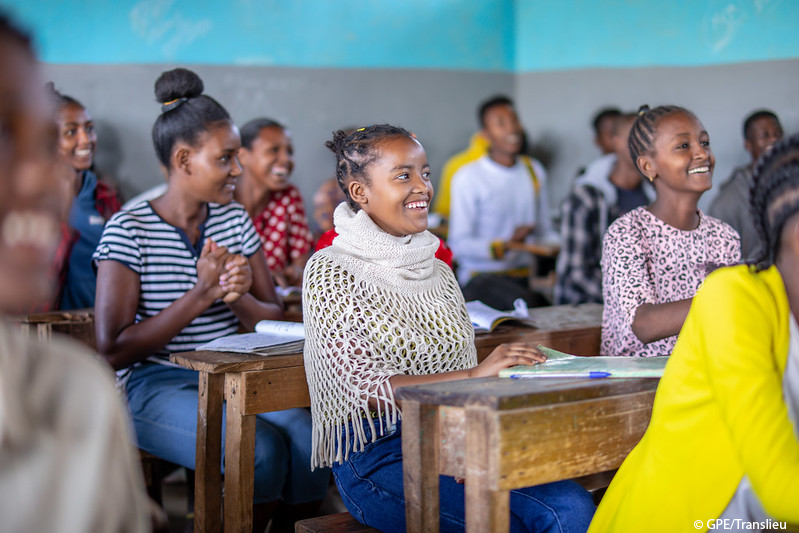
Not everything is stalled. Efforts to support girls’ education, improve sanitation, and strengthen community engagement are showing results. Digital learning, if thoughtfully applied, could bridge distance and resource gaps. University reforms focused on quality rather than size offer cautious hope.
Progress is slow, but not impossible.
Conclusion: Education as Lived Experience
Education in Ethiopia cannot be understood through numbers alone.
It lives in crowded classrooms, in teachers trying their best with limited tools, in parents waiting anxiously for exam results, and in students wondering whether their effort will finally pay off.
Until education policy begins with these lived realities — not just targets and timelines — progress will remain fragile.
For Ethiopia, the challenge is no longer access alone. It is dignity in learning, depth in understanding, and fairness in opportunity.
Only when education feels meaningful — not merely available — will its promise truly be fulfilled.