So, you’ve decided to prepare for the SSC CGL 2025 exam. That’s a great step! The Staff Selection Commission Combined Graduate Level (SSC CGL) exam presents a significant opportunity for those seeking a secure and respected government job.
But yes, we all know that the syllabus can feel like a big mountain at first. Don’t worry! This guide is here to make things easy for you, like a friend explaining everything step by step.
How the SSC CGL Exam Works – In Simple Words
The SSC CGL exam happens in two main stages:
Tier 1 – The First Step (Screening Test)
- It’s the first exam everyone has to take.
- It’s just to qualify – your marks here won’t count in the final selection.
- But you must clear the cut-off to move ahead.
Tier 2 – The Main Exam
- This is the most important stage.
- Marks from Tier 2 decide your final selection.
- There are some extra papers for special posts (like JSO or AAO).
Both stages are online exams, so it’s good to practice on a computer if you can.
Tier 1: What It Looks Like
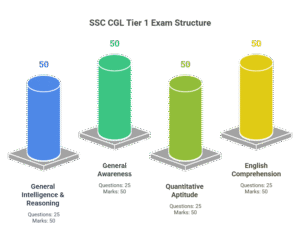
Time: 60 minutes | Questions: 100 | Total Marks: 200
| Subject | Questions | Marks | What It Includes |
| General Intelligence & Reasoning | 25 | 50 | Logic, puzzles, patterns |
| General Awareness | 25 | 50 | GK, current affairs, history, science |
| Quantitative Aptitude | 25 | 50 | Basic math (up to class 10 level) |
| English Comprehension | 25 | 50 | Grammar, vocabulary, reading skills |
Important: For every wrong answer, 0.50 marks gets deducted. So, guess only if you’re somewhat sure.
Let’s Break Down the Tier 1 Syllabus (In Simple Language)
- Quantitative Aptitude (Math)
This is school-level math. Don’t get scared by the name.
- Basic topics: Percentage, Profit & Loss, Interest
- Word problems: Time & Work, Speed & Distance, Pipes
- Fundamentals: Ratios, Averages, Number System
- Shapes: Triangles, Circles, Area & Volume (Mensuration)
- General Intelligence & Reasoning
This section is like fun brain puzzles.
- Patterns & Series: Number or letter series
- Puzzles: Blood relations, Coding-Decoding, Syllogisms
- Visuals: Mirror images, figure problems
- English Comprehension
Your basic English skills are tested here.
- Grammar: Error spotting, active/passive voice
- Vocabulary: Synonyms, antonyms, idioms
- Comprehension: Reading passages and fill-in-the-blanks (cloze test)
- General Awareness (GK)
This has many topics, but don’t worry – small, daily efforts help.
- Current Affairs: Last 6–8 months (national, international)
- Static GK: History, Geography, Polity, Important Days
- Science: Basics of physics, chemistry, and biology
Tier 2: The Real Test
Tier 2 is more detailed and challenging.
Paper I – For Everyone
This includes:
- Math (Quantitative Aptitude) – Similar to Tier 1, but harder.
- English Language & Comprehension – More grammar and longer passages.
- Computer Proficiency – Basic computer knowledge (MS Office, internet, etc.)
- Data Entry Speed Test (DEST) – You’ll type a short passage to test your typing speed.
Paper II – Statistics
- Only for those applying for the Junior Statistical Officer (JSO) post.
Paper III – Finance & Economics
- Only for those applying for Audit/Accounts Officer posts.
Chapter-Wise Weightage (What to Focus On)
Here’s where most questions usually come from:
- Math: Focus on Data Interpretation, Geometry, Trigonometry
- English: Strong areas are Reading Comprehension, Cloze Test, and Grammar
- Reasoning: Practice series, analogy, and non-verbal reasoning
- GK: Current Affairs and Static GK (history, polity, etc.) are very important
Smart Tips to Prepare Well
- Understand the Syllabus First
- Just read it once — no pressure to memorize.
- Make a Simple Study Plan
- Create a weekly timetable.
- Spend more time on weak areas, but don’t ignore your strong ones.
- Practice Mock Tests
- This will help you improve speed and confidence.
- Solve old question papers too.
- Stay Updated
- Read news or watch a GK YouTube channel for 20–30 minutes daily.
- Revise Regularly
- Our brain forgets — revise every few days in short sessions.
Final Words
Cracking SSC CGL is not about studying for 15 hours a day.
It’s about studying smartly for 4–5 hours daily with focus.
You don’t need to be from a big city or a top coaching institute. With a clear plan, hard work, and regular practice, you can absolutely succeed — no matter where you come from.
So, download the syllabus, pick one topic today, and start preparing.
You’ve got this!
Always check the official SSC website (ssc.gov.in) for the most accurate information.
If you want, I can also make a weekly study timetable or a chapter-wise checklist for you. Just ask!
Would you like this guide in PDF format, or translated into Hindi as well?
Top of Form
Bottom of Form