Introduction
A quiet but powerful shift is happening in education. There was a time when simply having a degree was enough to guarantee a job. Families believed that engineering, medicine, or commerce would automatically secure a stable future. But today, that belief is slowly breaking. The world is changing faster than the education system can keep up.
Imagine two students with the same degree, studying the same subjects for four years. One lands a ₹34 lakh package, while the other struggles to secure even ₹3 lakh. The difference is not the degree—it is everything around it: skills, environment, exposure, and mindset.
This is where the real question begins. It is no longer “Which degree is best?” but “Which degree, combined with the right skills and environment, will actually lead to a job?”
Let’s explore five degrees that still hold strong value in 2026—and more importantly, why they work.
The Uncomfortable Truth about Degrees in 2026
Before diving into the list, it is important to understand one harsh reality.
India produces nearly 15 lakh engineering graduates every year, yet only around 42% are employable. The remaining majority struggles—not because they lack degrees, but because they lack skills.
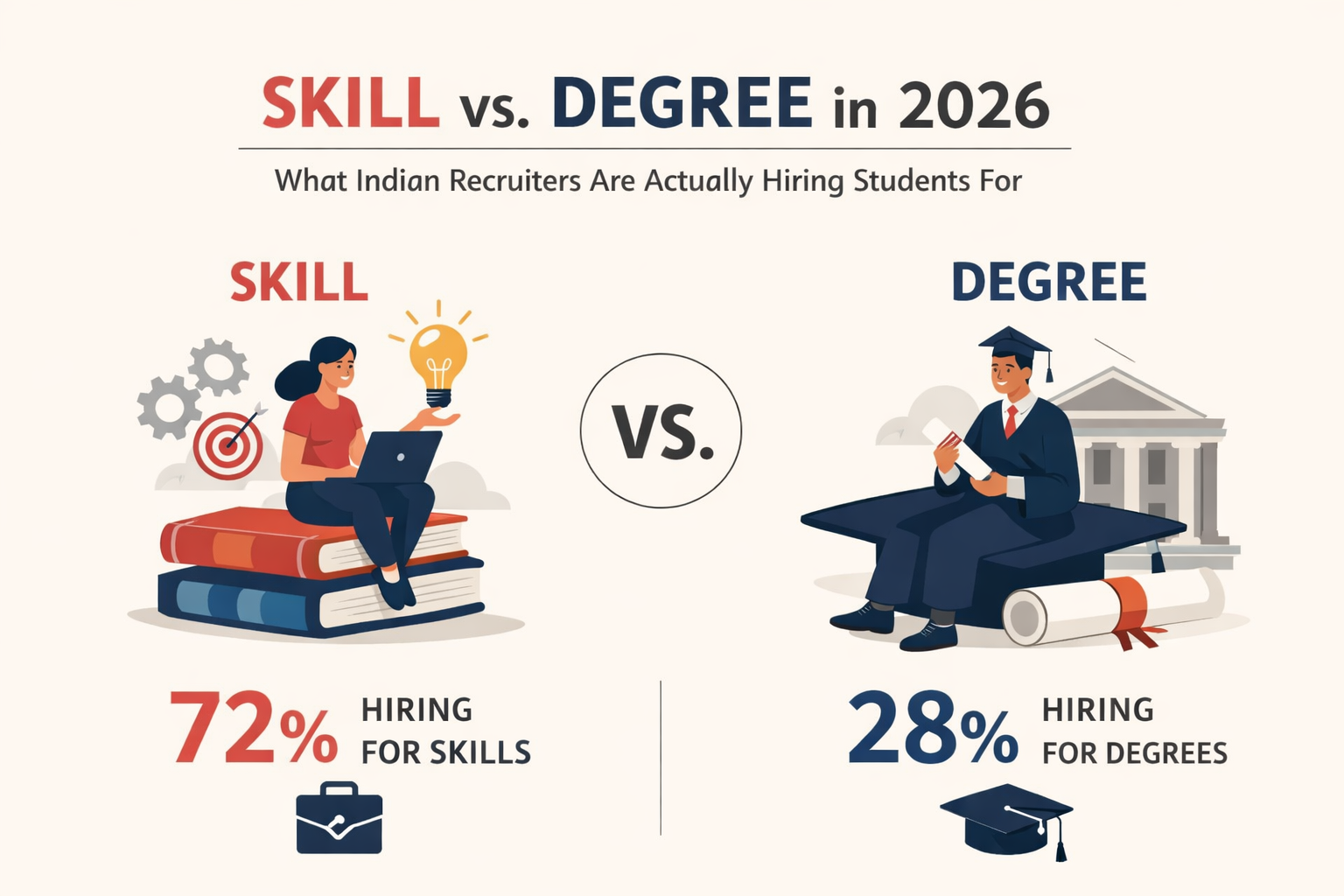
Companies are also evolving. Nearly 30% of organisations are moving towards skill-based hiring, reducing their dependence on degrees as a filtering tool.
This means one thing clearly:
A degree may open the door, but only skills will keep it open.

Degree #5: Applied Mathematics, Statistics & Data Science
At first glance, it may feel like artificial intelligence is taking over everything related to data and numbers. But the truth is quite the opposite.
Every AI system, every algorithm, and every backend model is built on mathematics. The people who understand data deeply are the ones building the future—not getting replaced by it.
However, not all maths degrees are equal. Pure theoretical mathematics may not always translate into direct job opportunities. But applied mathematics, statistics, and data science are deeply connected to real-world problems.
From insurance companies calculating risk to startups analysing customer behaviour, data is everywhere. Investment banks, trading firms, marketing agencies, and even governments rely on data-driven decisions.
Freshers in data roles often start with decent packages, but with experience and skills like machine learning, growth can be exponential.
If someone enjoys numbers and patterns, this path quietly becomes one of the most powerful career choices.
Degree #4: Specialised Business & Finance Degrees
General degrees like B.Com or BBA often fail to create strong career differentiation. They provide a foundation but rarely a competitive edge. What truly works today is specialisation.
An MBA in finance, marketing, analytics, or healthcare management carries far more value than a general business degree. Similarly, professional qualifications like Chartered Accountancy continue to remain highly respected and difficult to replace.
Even in a world driven by automation, businesses still need human judgment. Audits, compliance, strategic decisions—these cannot be fully handed over to machines.
However, there is a catch that many overlook. The institution matters deeply. An MBA from a top-tier institute can transform a career, while the same degree from a lesser-known college may not create significant impact. The environment, peer group, and exposure shape thinking far more than the curriculum itself.
In business education, where one studies often matters more than what one studies.
Degree #3: Modern Engineering (Not the Traditional Ones)
Engineering still holds value, but not in the way it used to. Traditional branches like civil or mechanical engineering are no longer the default “safe” options. The demand has shifted towards emerging and technology-driven fields.
Electrical engineering, electronics, semiconductor technology, aerospace, and computer science are leading the change. With industries like electric vehicles, green energy, and space technology expanding rapidly, these fields are gaining strong momentum.
But here, the gap between colleges becomes even more visible. Graduating from a top institute creates exposure, peer learning, and opportunities that are difficult to replicate elsewhere. It is not just about placements—it is about the mindset one develops.
Being surrounded by ambitious, curious, and capable individuals pushes a person to grow faster than any syllabus ever could.
Degree #2: Law from Top Institutions
Law has quietly become one of the most stable and high-demand careers. Whether the economy is booming or slowing down, legal professionals are always needed. Companies merge, contracts are signed, disputes arise, regulations evolve—lawyers are essential at every stage.
The rise of legal tech, data privacy laws, cybersecurity regulations, and startup ecosystems has further increased demand. Corporate law, mergers and acquisitions, compliance, and intellectual property are areas where opportunities continue to grow. However, like other fields, the institution plays a defining role. Top law universities create stronger networks, better exposure, and higher-quality opportunities. A good law degree does not just offer a job—it builds long-term career stability.
Degree #1: Healthcare & Medical Sciences
If there is one field that remains deeply human, it is healthcare. Technology can assist, analyse, and automate—but it cannot replace the human touch required in patient care. A machine may read reports, but a doctor provides reassurance, understanding, and trust. Healthcare continues to grow rapidly, driven by increasing population, awareness, and access to medical services.
However, the real growth in this field comes after specialisation. Fields like cardiology, neurosurgery, oncology, and advanced medical practices offer strong earning potential and long-term stability.
At the same time, opportunities are expanding beyond doctors. Nursing, physiotherapy, occupational therapy, and healthcare management are becoming equally important. Hospitals are not just places of treatment anymore—they are complex organisations that require skilled professionals at multiple levels.
Industries that will Shape Jobs in 2026
Choosing the right degree becomes easier when one understands where the world is heading. Industries like semiconductors, electric vehicles, green energy, space technology, cybersecurity, fintech, and healthcare are expanding rapidly.
These sectors are not just creating jobs—they are creating entirely new career paths. Aligning education with these industries increases the chances of long-term growth and relevance.
What Really Matters: Degree or College?
This is where most students get confused. It may seem logical that the course matters more than the college. But in reality, the environment shapes the individual. The people one interacts with, the conversations one has, the exposure one receives—these influence thinking, ambition, and confidence.
Even an average course from a strong institution can create better outcomes than a top course from a weak environment.
And if the ideal college is not accessible, there is still a way forward.
The internet has removed boundaries. Communities, mentors, and opportunities exist beyond physical classrooms. What matters is the willingness to seek them.
FAQs
Q1. Which degree is best for jobs in 2026?
There is no single “best” degree. Fields like data science, healthcare, law, specialised business, and modern engineering show strong demand.
Q2. Are degrees becoming useless?
No, but their importance is decreasing compared to skills and real-world application.
Q3. Does college really matter more than the degree?
In many cases, yes. The environment, peer group, and exposure significantly impact career growth.
Q4. Can skills replace degrees completely?
Not entirely, but skills are becoming the primary factor in hiring decisions.
Q5. What should students focus on today?
Building practical skills, choosing the right environment, and staying aligned with future industries.
Conclusion
The idea of education is changing quietly but powerfully. Degrees still matter, but they are no longer the deciding factor. Skills, mindset, and environment have taken their place. The future does not belong to those who simply study—it belongs to those who adapt, learn, and apply.
Choosing one of these five degrees may increase the chances of success, but the real difference will always come from how that degree is used. Because in 2026, it is not the degree that gets the job. It is the person behind it.