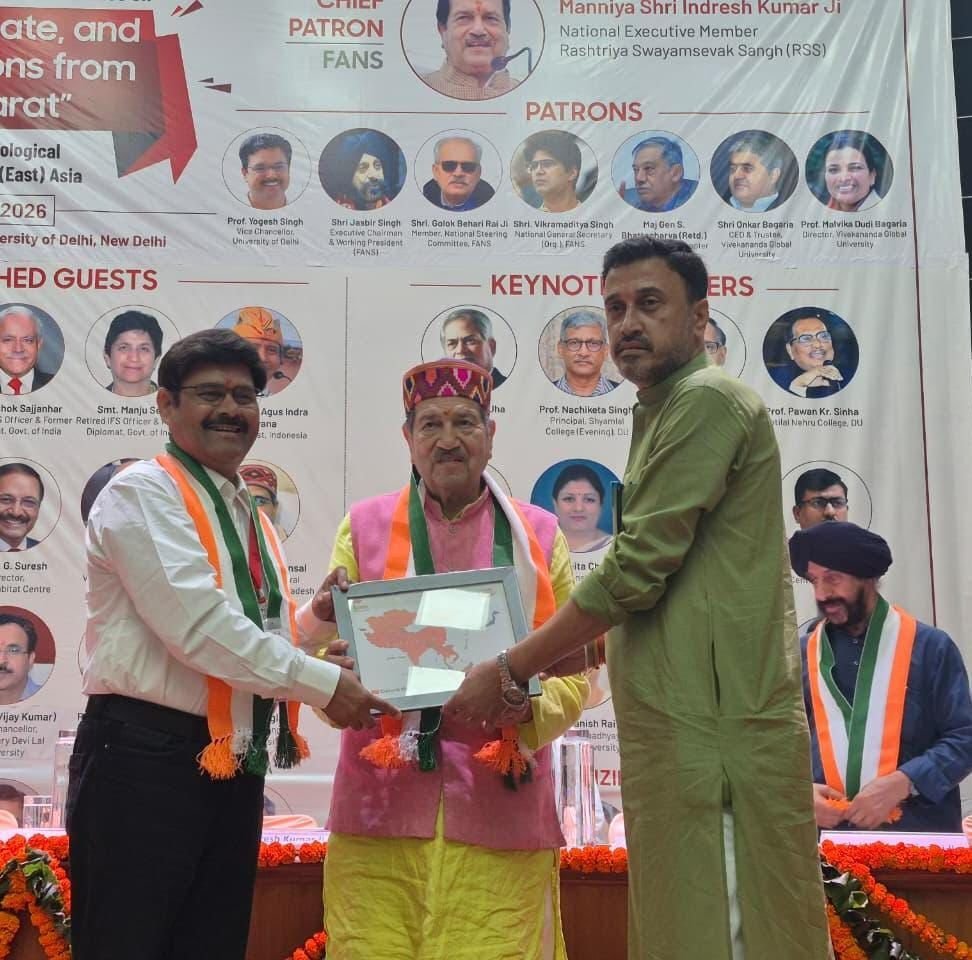
Dr Indresh Kumar urges youth to remain devoted to Indian culture and the motherland
“The ideals of Indian youth are not Kasab but Kalam,” says Dr Indresh Kumar
New Delhi, March 27
Dr M Rahmatullah
A two-day international conference on “Culture, Climate and History: Lessons from Vishal Bharat” was inaugurated today at the University of Delhi. The conference is being organised by the Forum for Awareness of National Security (FANS) in collaboration with Vivekananda Global University, Jaipur, the Centre for Himalayan Studies, University of Delhi, and the Nelson Mandela Centre for Peace and Conflict Resolution, Jamia Millia Islamia. The event has brought together a large number of scholars, thinkers, social activists and researchers from India and abroad.
Addressing the inaugural session, Dr Indresh Kumar, Chief Patron of FANS and a member of the National Executive of the RSS, called upon the youth to remain devoted to Indian culture, civilisation and the motherland. He said that the primary objective of the session was to “sow the seeds of nationalism” in the minds of young people. Sharing his experiences from interactions with youth across different sections of society, he noted that young Indians are firmly committed to strengthening their “Hindustani identity” and are increasingly aware of ideological manipulations by foreign forces.
Dr Indresh Kumar reminded the youth of the sacrifices made by India’s freedom fighters who embraced martyrdom for the nation with a deep sense of nationalism. He emphasised that the core values of India are rooted in love, brotherhood and tolerance, which convey a message of peace to the world. Appreciating the efforts of FANS, he said that the organisation is playing an important role in encouraging young people to uphold these values with courage and conviction.
In his address, he remarked that the ideals of Indian youth are not terrorists like Kasab but the great scientist and former President Dr A.P.J. Abdul Kalam, whose life and ideas continue to inspire young Indians towards nation-building.
Senior journalist and political analyst Harshvardhan Tripathi highlighted the significance of the Indian family system. He said that it nurtures socio-cultural values such as empathy, balance and sustainability. At a time when the world is facing multiple crises, he observed, the Indian value system has the potential to guide global society.
Noted social activist from Indonesia and Padma Shri awardee Agus Indra Udayana expressed his happiness at the inclusion of Indonesia in the cultural imagination of “Vishal Bharat.” He also appreciated India’s support in the restoration and preservation of the historic Prambanan Temple in Indonesia.
Acharya Lokesh Muni, Founder of Ahimsa Vishwa Bharati, emphasised that the emotional and mental well-being of youth is essential for building a strong and prosperous nation. He suggested that moral education and value-based learning should be integrated into primary education so that the coming generations develop compassion and a sense of social responsibility.
Jasbir Singh, Executive Chairman of FANS, recalled India’s historic legacy as a global centre of knowledge. He said that the dialogues and initiatives organised by FANS are aimed at reviving and strengthening this proud intellectual tradition.
Prof B.W. Pandey, Director of the Centre for Himalayan Studies at the University of Delhi, stated that the vision of “Vishal Bharat” cannot be realised without a “Viksit Bharat.” Referring to his international experiences, he said that the world increasingly recognises India’s continuous growth and its expanding global potential.
Senior journalist and political analyst Uday Mahurkar spoke about the role of Veer Savarkar in shaping the idea of a strong India and highlighted his sacrifices for the nation. He also pointed out that the growing prevalence of distorted crimes in society is partly linked to the spread of pornographic content and stressed the need for social awareness and policy interventions to address the issue.
Vikramaditya Singh, National General Secretary of FANS, described dialogue (samvad) as one of the defining features of Indian civilisation. He explained that national security in India is not limited to military strength alone but is strengthened by the collective consciousness and participation of society. This, he said, is one of the reasons why India continues to remain “an island of peace in a sea of chaos.”
The inaugural session concluded with the release of Dr Shakeel Hussain’s book “Vishal Bharat: Cultural and Civilisational Consciousness.”
Among those present on the occasion were Golok Bihari Rai, Prof Vijay Kumar (Galgotias University), Prof Anil Soumitra, Dr Rajeev Pratap Singh, Dr Saishtha Sami, Dr Varnika Sharma, and Prof Geeta Singh, along with a large number of scholars, researchers and intellectuals from India and abroad.
Following the inaugural session, two technical sessions were held in which scholars presented their research papers and engaged in detailed discussions on the cultural, historical and contemporary dimensions of the theme “Culture, Climate and History: Lessons from Vishal Bharat.”