The University Grants Commission, commonly known as the UGC, plays a very important role in India’s higher education system. In simple terms, it is the body that looks after universities — how they function, how much money they get, and whether the quality of education is up to the mark. But the UGC did not appear overnight. Its journey is closely linked with India’s own journey from colonial rule to an independent nation trying to educate its people.
How the Idea of UGC Started (Before Independence: 1944–1947)
The idea of a central body for universities came up during the last years of British rule. In 1944, a report known as the Sargeant Report pointed out a serious problem — universities in India were growing, but there was no proper planning, no uniform standards, and no clear system of funding.
The report suggested that higher education needed:
- Proper financial support
- Academic supervision
- A coordinated system so that universities did not move in different directions
Based on this thinking, the British government set up a University Grants Committee in 1945. At first, its role was very limited. It mainly looked after a few important universities such as:
- Aligarh Muslim University
- Banaras Hindu University
- University of Delhi
By 1947, things changed quickly. The number of universities increased, and it became clear that a bigger system was needed. So, the committee’s work was extended to cover all universities in India. This was the first real step toward a national-level education regulator.
After Independence: A New Vision for Education (1948)
After India became independent, education was seen as the backbone of nation-building. Leaders believed that without strong universities, the country could not move forward.
In 1948, the Government of India set up the University Education Commission, led by Dr. S. Radhakrishnan, who later became the President of India. This commission carefully studied the condition of Indian universities.
What it found was worrying:
- Uneven quality of education
- Poor funding systems
- Big gaps between regions and institutions
The commission clearly said that India needed a permanent and powerful body to:
- Coordinate university education
- Distribute funds fairly
- Maintain academic standards
- Avoid regional imbalance
It suggested modelling this body on the UK’s University Grants Commission. This recommendation laid the foundation of what we now know as the UGC.
Inception of the UGC (1953)
Acting on these ideas, the University Grants Commission was officially established on 28 December 1953. The inauguration was done by Maulana Abul Kalam Azad, India’s first Education Minister.
At this stage, the UGC did not have legal powers. It worked as an advisory and funding body. Even so, its role was very important. It helped universities grow, guided them academically, and ensured they received financial support during the early years of independent India.
UGC Gets Legal Power (1956)
A major turning point came in 1956, when Parliament passed the University Grants Commission Act, 1956. This law gave UGC full legal authority.
After this, UGC was officially empowered to:
- Decide and maintain standards of teaching and research
- Give grants to universities and colleges
- Recognise universities and institutions
- Advise Central and State governments on higher education
This law made UGC the main guardian of quality and discipline in Indian higher education.
How UGC Works
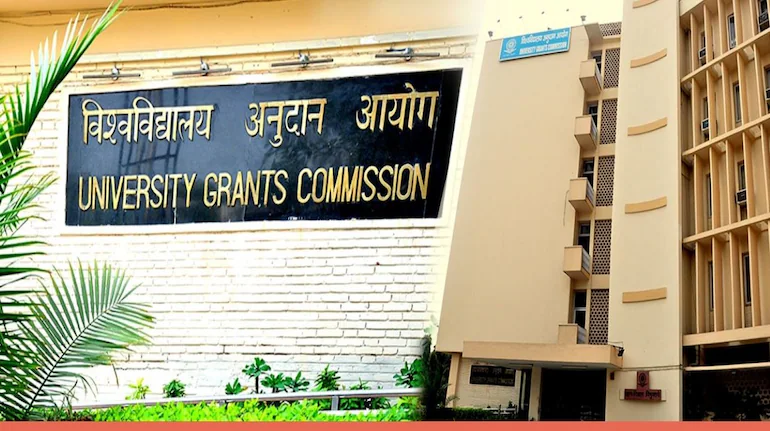
UGC is headquartered in New Delhi. It has:
- A Chairman
- A Vice-Chairman
- Ten other members
All members are appointed by the Central Government. Over the years, UGC has influenced almost every aspect of university education — from funding and recognition to quality control and expansion.
An Institution that Keeps Changing
UGC has never remained fixed. As times change, it has tried to adapt. Current debates, including those around UGC Rules, 2026, show that the commission is still evolving to deal with issues like:
- University autonomy
- Better governance
- Regulation without over-control

The Major Takeaway
The history of UGC is really the story of India trying to balance growth, quality, and fairness in higher education. From a small committee under British rule to a powerful national regulator, UGC has shaped how universities function today — and it continues to change as new challenges emerge.
(Written by Saumya Jyotsna, Muzaffarpur, Bihar)