India’s civil services have always symbolised authority, responsibility and nation-building. For lakhs of UPSC aspirants, becoming an officer in the Indian Administrative Service (IAS), Indian Police Service (IPS) or Indian Forest Service (IFS) is not just a career goal — it is a life mission.
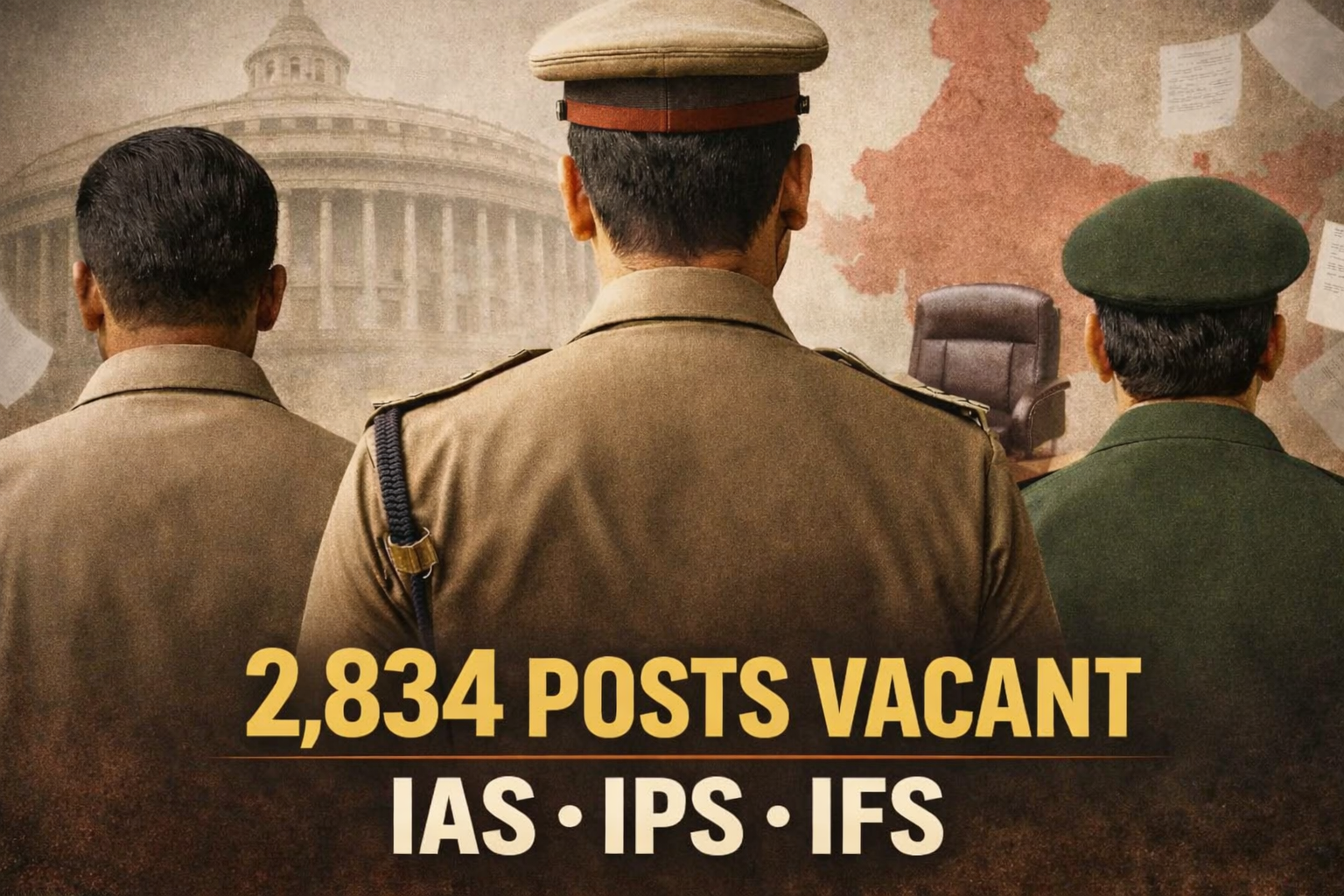
But recent data presented in Parliament reveals something concerning: 2,834 posts across these three elite services are currently vacant. This is not a small administrative detail. It reflects a significant gap in India’s governance structure.
Let’s understand what this really means.
The Numbers Behind the Vacancy Crisis
As of 1 January 2025, the total number of vacant posts in IAS, IPS and IFS stands at 2,834. When broken down, the picture becomes clearer and more serious.
In the IAS, out of a sanctioned strength of 6,877 officers, only 5,577 are currently in service. That leaves around 1,300 posts unfilled. These officers are responsible for district administration, policy execution, and coordination between state and central governments. A shortage here means heavier workloads and stretched administrative capacity.
The IPS shows 505 vacant posts out of 5,099 sanctioned positions. IPS officers lead police forces, maintain law and order, and manage internal security. At a time when crime patterns are evolving rapidly, leadership gaps in policing cannot be ignored.
The IFS faces the sharpest proportional shortage. Out of 3,193 sanctioned posts, only 2,164 officers are serving, leaving 1,029 vacancies. Forest officers are crucial for environmental governance, wildlife protection and climate-related policy enforcement. With increasing ecological challenges, this gap is particularly worrying.
Together, these figures indicate that nearly one-fifth of sanctioned posts remain unfilled.
Why do these Vacancies Exist?
Civil services recruitment is not a quick process. The examination conducted by UPSC takes almost a year from notification to final result. After selection, officers undergo intensive training before being posted. This naturally creates time gaps.
However, recruitment delays are not the only reason. Annual retirements, voluntary retirements and expansion of sanctioned strength also contribute. When the government increases the number of authorised posts but recruitment numbers do not immediately rise proportionally, vacancies accumulate.
Cadre management between states and the Centre also plays a role. Some states face more acute shortages than others, which affects regional governance unevenly.
How Vacancies Affect Governance on the Ground
Numbers on paper may look abstract, but their impact is real.
An IAS officer in a district might be handling multiple additional charges because sanctioned positions are empty. That means development schemes, grievance redressal and administrative decisions may slow down.
An IPS officer overseeing a large jurisdiction with limited senior support may face operational strain. Law enforcement today requires strategic planning, technological adaptation and constant supervision.
In the case of IFS, fewer officers mean greater pressure on existing staff to manage forests, prevent illegal activities and respond to environmental crises.
Officers are trained to handle responsibility, but consistent overload affects efficiency over time.
Representation and Recruitment Trends
The government also shared recruitment data for reserved categories over the past five years. Appointments of OBC, SC and ST candidates continue across these services, reflecting efforts toward inclusive representation.
However, while representation figures are important, the broader issue remains the overall shortage. Diversity in recruitment must go hand in hand with adequate numbers to maintain administrative strength.
What this Means for UPSC Aspirants
For aspirants preparing day and night, this news creates mixed emotions.
On one hand, vacancies suggest opportunity. The system clearly needs officers. On the other hand, vacancies do not automatically mean a sharp increase in yearly recruitment. UPSC notifications depend on requisitions from departments and training capacity.
Aspirants should not assume that 2,834 vacancies will translate into 2,834 immediate openings in one exam cycle. Recruitment planning is more structured and phased.
What this situation truly highlights is the importance of committed, capable officers. The need is genuine.
Is Reform Needed in Civil Services Recruitment?
The vacancy data naturally raises policy questions. Should recruitment cycles be faster? Should training capacity at academies expand? Should administrative reforms address structural delays?
Some experts argue for improving cadre planning and forecasting retirements more accurately. Others suggest that better coordination between the Centre and states could prevent accumulation of vacancies.
These are long-term governance discussions, but the urgency is visible.
The Larger Picture: Governance in a Growing Nation
India is a country of immense scale and complexity. Governance requires not only policies but people to implement them. Every vacant post represents an additional burden on someone already in service.
Despite shortages, the civil services continue functioning. Officers work beyond defined roles to maintain continuity. But resilience should not replace adequacy.
Strong administrative depth ensures quicker decisions, better crisis management and smoother policy implementation. Vacancies weaken that depth.
Final Thoughts
The revelation of 2,834 vacant posts in IAS, IPS and IFS is more than a headline. It is a reminder that governance is a human system. It depends on trained individuals willing to take responsibility.
For aspirants, this is not just information — it is motivation. The system needs officers who are prepared, competent and driven by purpose.
For policymakers, it is a signal that strengthening recruitment and cadre management must remain a priority.
And for citizens, it is a quiet insight into how administrative gaps can influence everyday governance.
India’s civil services remain one of the strongest pillars of the nation. But even strong pillars need reinforcement.